
(210) 496-3325
A pergola filters the sun. A patio cover blocks it entirely — along with rain, debris, and the heat that drives San Antonio homeowners indoors from May through September. Paradise Decks & Spas designs and installs custom patio covers across San Antonio and surrounding communities, built to match your home’s roofline and handle South Texas weather year after year.
By [Owner Name], Founder & Lead Deck Specialist · Last Updated June 2026
The most common complaint we hear from homeowners who had a patio cover installed by someone else: it looks bolted on. The roofline doesn’t match. The posts are too skinny for the span. The fascia doesn’t align with the home’s existing trim. The result is a structure that provides shade but makes the house look like it had an afterthought attached to it.
Our approach is different. Every patio cover installation starts with your home’s existing architecture — roofline pitch, fascia profile, exterior material, and trim style. We design the cover to tie in cleanly, match the existing roofline angle where applicable, and use post sizing and beam depth proportional to the structure’s span. The finished result looks like it was designed with the house, not added to it years later.
As a full-service outdoor living company with 19+ years of completed projects across Bexar, Comal, Kendall, and Bandera counties, Paradise Decks & Spas builds patio covers as standalone additions and as part of larger deck and outdoor living projects — with permits handled, HOA documentation prepared, and a fixed price in writing before any work starts.
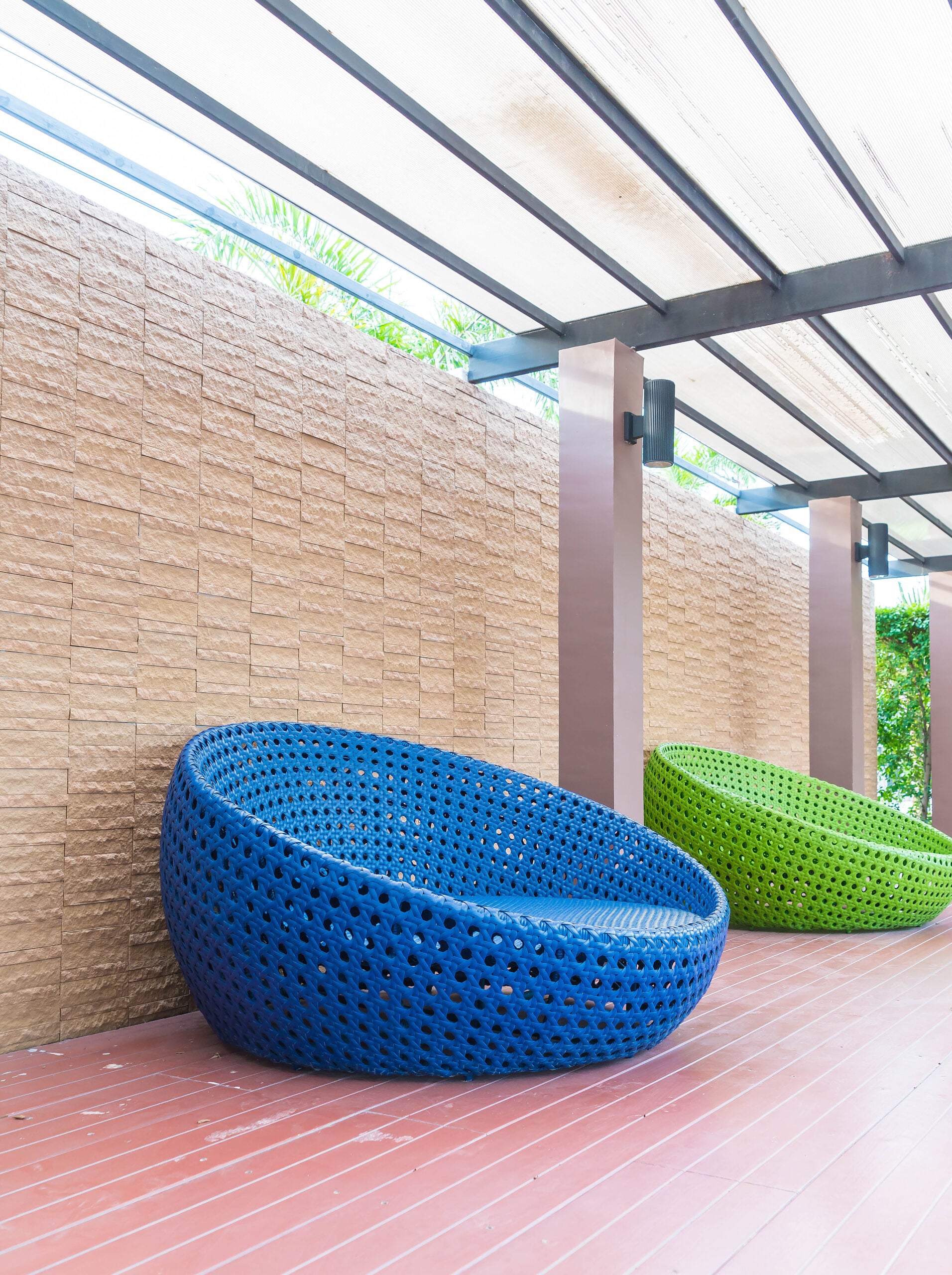
This is the first question worth settling before anything else.
A pergola has open rafters — it creates filtered shade, defines a space, and provides architectural character. It does not block rain. On a hot San Antonio afternoon with the sun directly overhead, a pergola provides meaningful but incomplete relief.
A patio cover has a solid or insulated roof panel — it blocks 100% of rain, provides full shade, and creates a space that’s genuinely usable in weather a pergola can’t handle. A covered patio in San Antonio stays functional during summer afternoon thunderstorms, protects outdoor furniture from UV damage, and can be fitted with ceiling fans and lighting for a complete outdoor room feel.
If your primary goal is rain protection, full shade, and year-round usability — you need a patio cover. If your primary goal is architectural character, climbing plant support, or partial shade — a pergola may be the right fit. If you want both, many of our projects combine a solid covered section over a dining or kitchen area with an open pergola section over a lounge zone.
Not all patio cover projects are the same. Here are the most common patio cover design ideas our San Antonio clients bring to us — and how we approach each one.
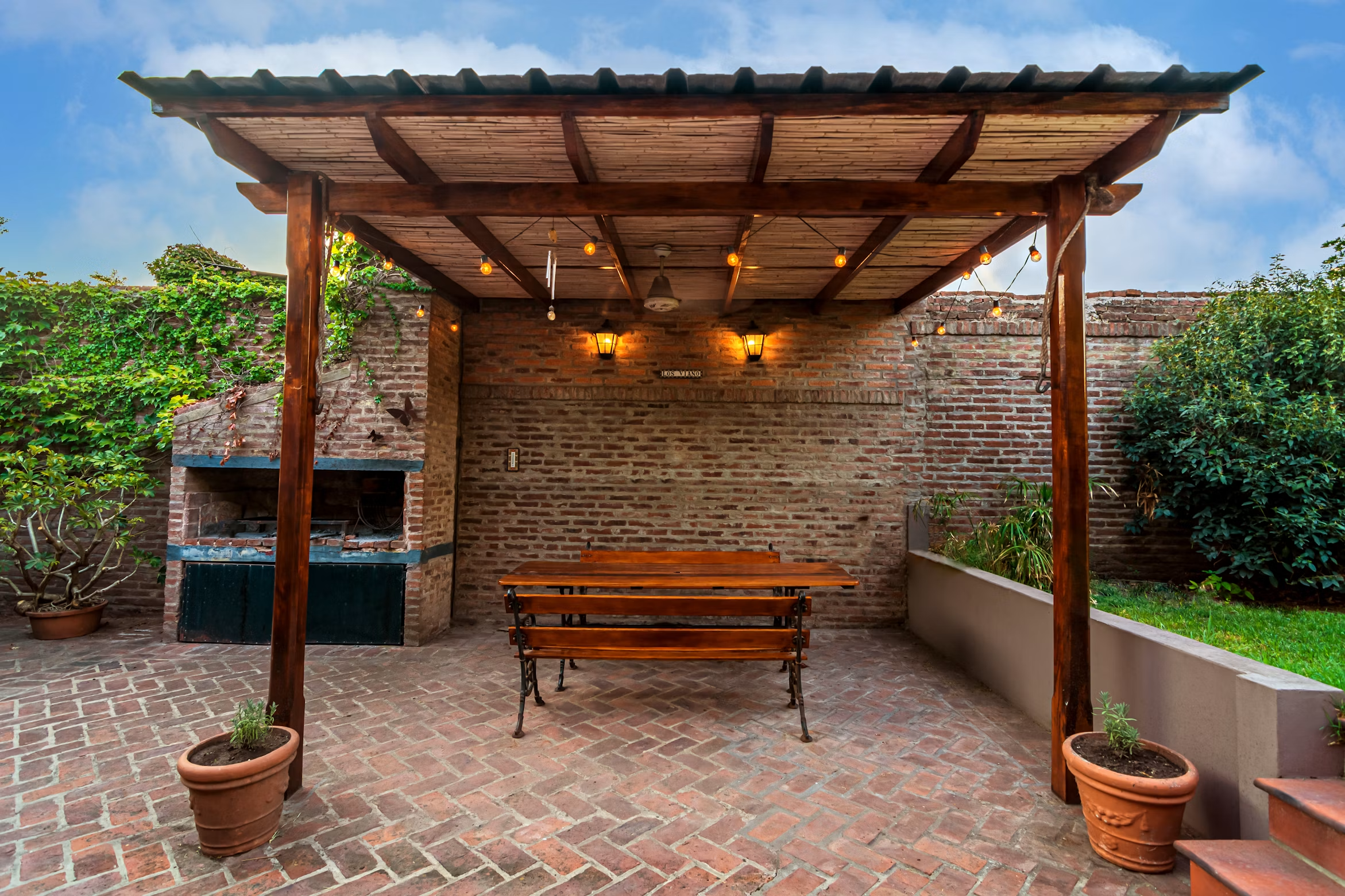
The most common patio cover installation in San Antonio is an attached solid roof cover — a framed structure that connects to the home’s exterior wall via a ledger board and extends outward over the patio or deck. The roof uses standard framing with sheathing and roofing material matched to the home’s existing roof — shingles, metal, or standing seam — so the addition reads as part of the home rather than a separate structure.
Attached solid roof patio covers require proper ledger attachment with through-wall flashing to prevent moisture intrusion, beam sizing adequate for the roof span, and column sizing proportional to the structure’s scale. We engineer every attached cover for San Antonio’s wind load requirements and integrate gutters where the cover’s roof drainage requires them.
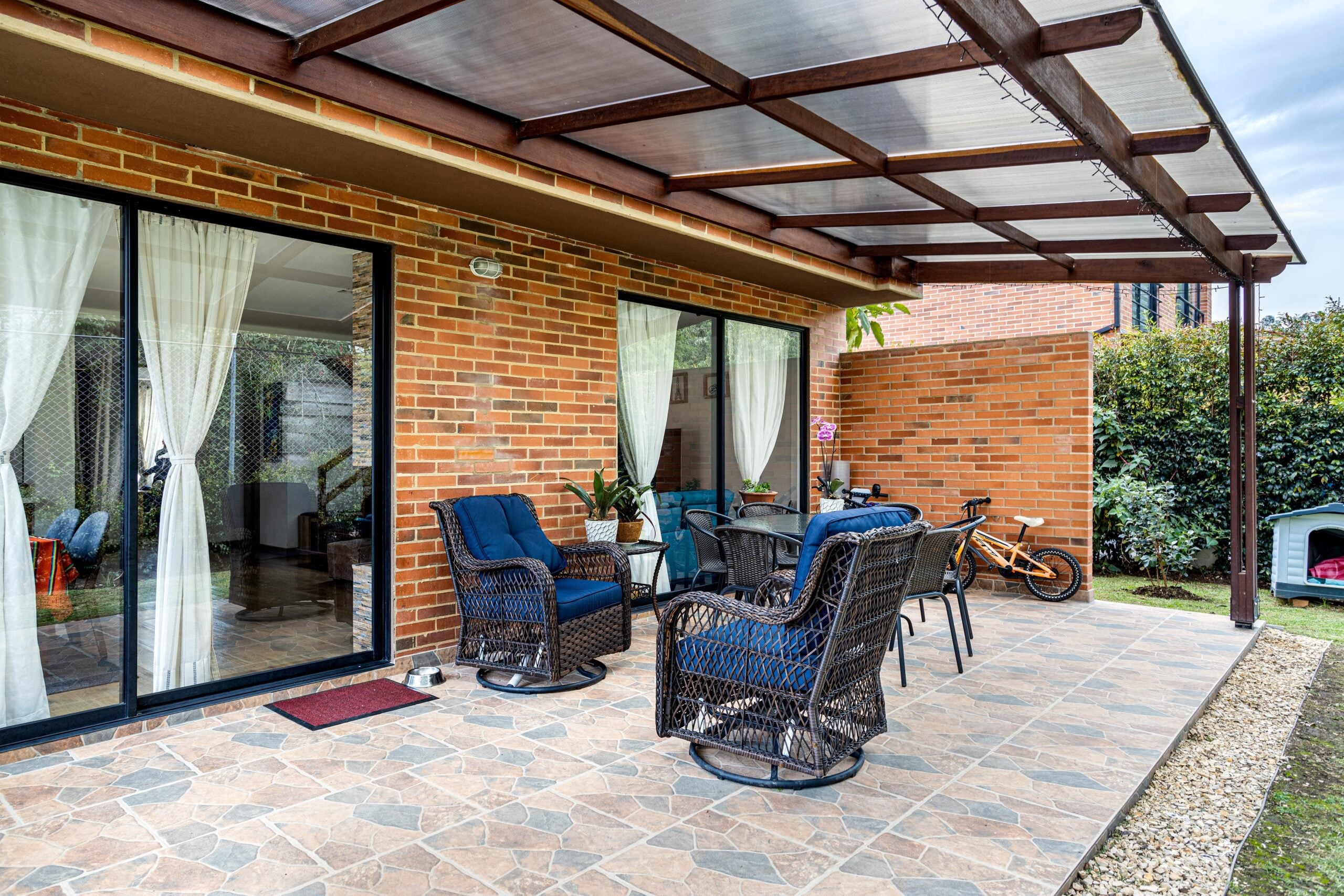
An insulated patio cover uses foam-core insulated roof panels — typically 2–4 inch thick aluminum-faced panels with a foam insulation core — instead of standard framing and roofing. The result is a finished ceiling on the underside, a weatherproof roof on top, and significantly better thermal performance than a standard framed cover.
Insulated patio covers are the most popular premium option in San Antonio because the insulated ceiling panel keeps the space underneath noticeably cooler than an uninsulated roof in direct Texas sun. They also provide a cleaner, more finished look on the interior ceiling face — no exposed rafters or sheathing — and are available in white, tan, and bronze finishes that coordinate with most San Antonio home exteriors.
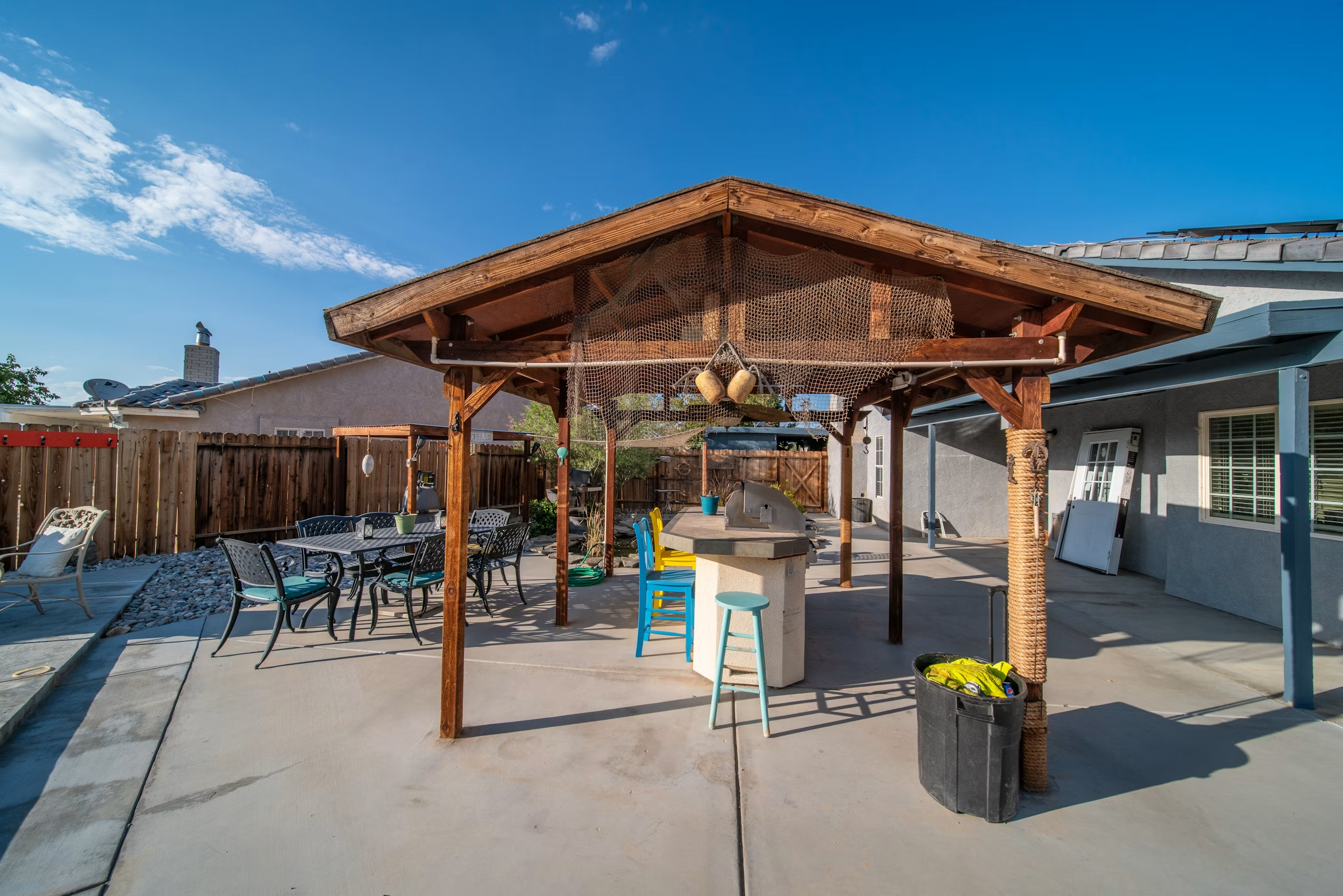
Wood patio covers — framed with pressure-treated lumber and finished with cedar or composite trim — are the right choice when the architectural character of a natural wood structure matters more than low maintenance. Wood covers can be designed with decorative rafter tails, corbels, and beam profiles that aluminum systems can’t replicate, making them the preferred option for craftsman, farmhouse, and Hill Country architectural styles.
Wood patio covers require more ongoing maintenance than insulated aluminum covers — paint or stain every 3–5 years and periodic inspection of fasteners and framing — but deliver an aesthetic warmth and customizability that no prefabricated system matches.
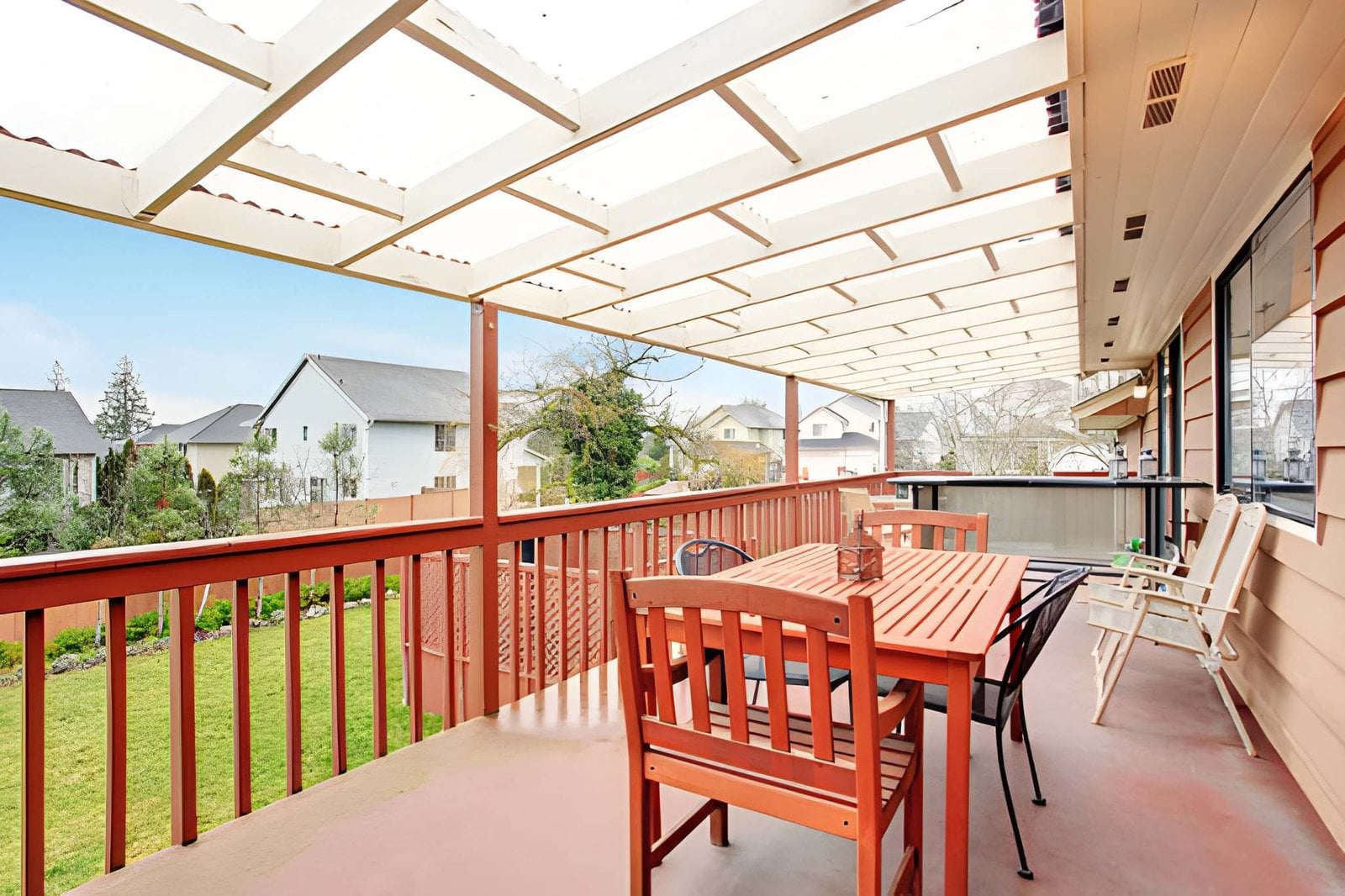
A freestanding patio cover is entirely self-supported — four or more columns on concrete footings with no attachment to the home. Freestanding covers are the right choice when the patio is positioned away from the home’s exterior wall, when ledger attachment isn’t structurally feasible, or when the homeowner wants a pavilion-style structure rather than a home extension.
Freestanding patio covers require properly sized footings — especially in San Antonio’s expansive clay soil — and lateral bracing to handle wind loads without the home’s structure as a support point. We engineer every freestanding cover for the span, load, and wind conditions at your specific site.
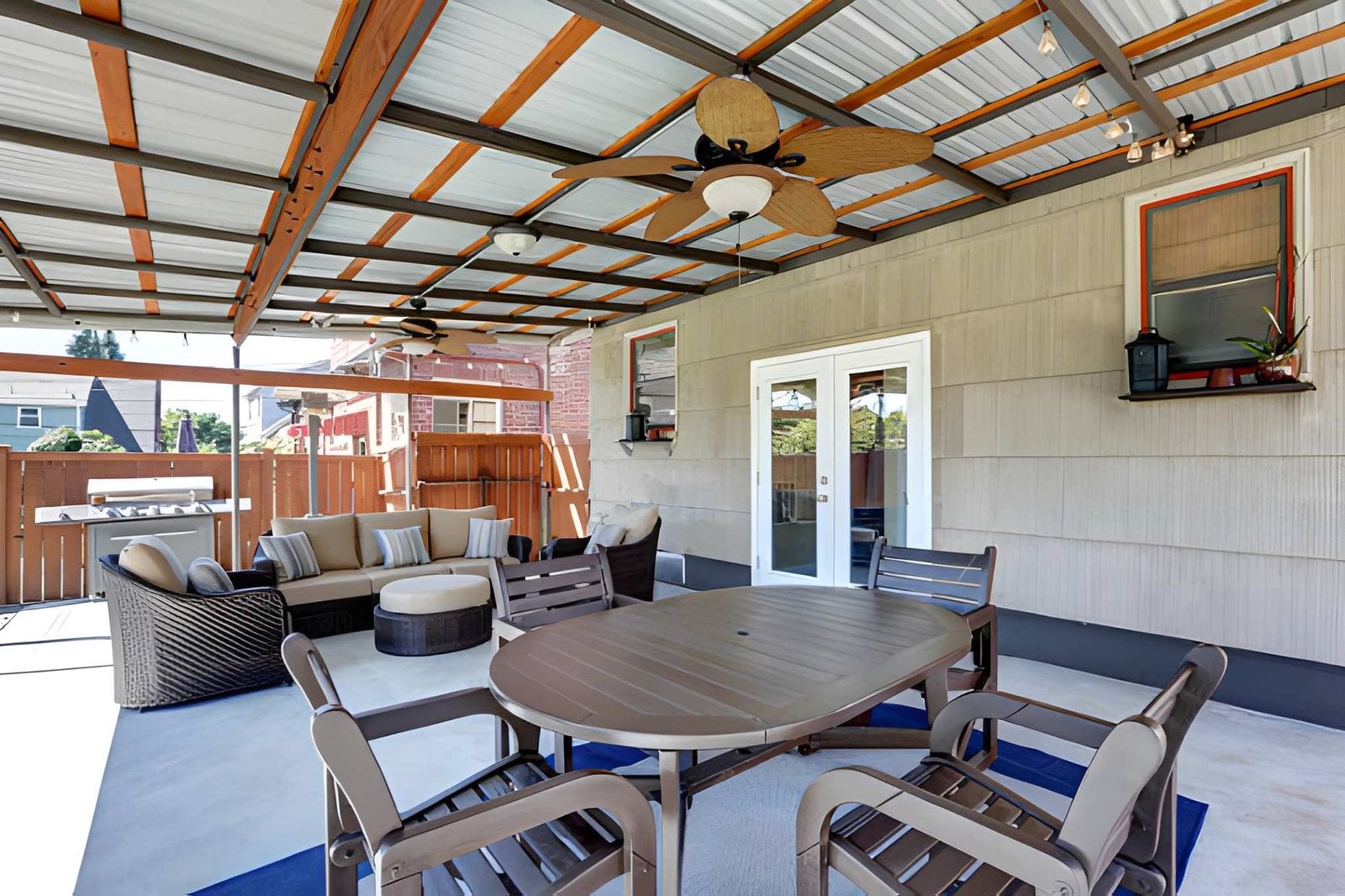
The most used patio covers in San Antonio are the ones that include ceiling fans and lighting — because a covered space without air movement is still hot, and a covered space without lighting is unusable after dark. We run electrical for ceiling fans, recessed LED lights, and outlet circuits inside the cover’s framing during construction — everything hidden, nothing surface-mounted afterward. Ceiling fan placement is calculated for the cover’s square footage so air circulation is effective across the full space, not just directly below the fan.
Most patio cover failures in San Antonio trace back to the same handful of issues:
Inadequate ledger flashing. The most common cause of water damage on attached patio covers — water infiltrates behind the ledger board and into the home’s wall framing. We install through-wall flashing with a proper drainage gap on every attached cover.
Undersized posts and beams. A post that’s structurally adequate for the span often looks spindly at that span — and an undersized beam deflects visibly over time. We size structural members for both engineering requirements and visual proportion.
No provision for roof drainage. A solid patio cover collects rain from its entire roof area and needs to direct that water away from the home’s foundation and the patio surface below. We design gutter and downspout systems into every cover that requires them.
Roofline mismatch. A cover that doesn’t match the home’s existing roofline pitch, material, or fascia profile looks like an addition. We match all three during the design phase.
Permit-skipping. Most attached patio covers in San Antonio require a building permit. An unpermitted cover creates liability at resale and potential insurance issues. Every cover we build gets the permit it requires.
Step 1 — Free On-Site Consultation We visit your property, evaluate the patio location, and discuss your goals — full weather protection, ceiling fans and lighting, attachment to the home or freestanding, material preference, and budget range. We assess your home’s roofline, existing exterior, and HOA requirements during this visit.
Step 2 — Design & 3D Rendering We produce a design showing your patio cover’s exact dimensions, roof pitch, post placement, and material finish. You see how it integrates with your home before we finalize anything.
Step 3 — Fixed-Price Written Quote You receive a written scope of work and a fixed-price quote covering all materials, framing, roofing, electrical rough-in, and labor. The number you approve is the number you pay.
Step 4 — Permit (Where Required) Most attached patio covers in San Antonio require a building permit. We prepare drawings, submit to the City of San Antonio Development Services or your local jurisdiction, and handle all inspection scheduling.
Step 5 — Construction We set footings for freestanding covers or install the ledger board with proper flashing for attached covers, then frame, roof, and finish the structure. Electrical for fans and lighting is run during framing. Gutters and downspouts are installed where required.
Step 6 — Final Walkthrough We walk the completed cover with you, confirm fan and lighting operation, review any care instructions, and hand over warranty documentation.
Primary Service Area: San Antonio, TX
Surrounding Communities: Stone Oak · Alamo Heights · Helotes · Schertz · Cibolo · Universal City · Converse · Boerne · Bulverde · New Braunfels · Canyon Lake · Lake Medina · Bandera
For low-maintenance, long-term performance in San Antonio’s heat and UV environment, insulated aluminum panel covers are the top recommendation — they stay cooler underneath than standard framed covers, require no painting or staining, and hold up without maintenance for decades. For homeowners who want the warmth and customizability of wood construction, pressure-treated framing with cedar finish trim and a matched shingle roof is the premium option — more maintenance but more architectural flexibility. We walk you through the tradeoff during your free consultation with real material samples.
In most cases, yes. San Antonio requires a building permit for attached patio covers and for freestanding covers exceeding certain square footage thresholds. Surrounding jurisdictions — Schertz, Boerne, New Braunfels, and others — have their own permit requirements separate from San Antonio. We verify requirements for your specific address, prepare all permit drawings, and handle the complete submittal and inspection process.
A patio cover has a solid or insulated roof — it provides full rain and sun protection. A pergola has open rafters — it provides filtered shade but no rain protection. If you want to use your outdoor space during San Antonio’s summer afternoon thunderstorms, you need a patio cover. If you primarily want architectural character and partial shade, a pergola may be sufficient. Many of our projects combine both — a solid covered section over a dining or kitchen area and an open pergola section over a lounge zone.
Yes — and this is one of our most common projects. We evaluate your existing deck’s structural condition and framing layout, confirm the ledger attachment point on the home is appropriate, and design the cover to integrate cleanly with both the deck and the home’s roofline. If the existing deck needs any structural reinforcement at the post locations, we include that work in the quote.
The ledger board — where the patio cover attaches to your home — is the most critical detail on any attached cover installation. We install through-wall flashing with a drainage gap behind the ledger, seal all penetrations, and slope the cover roof away from the home to direct water into gutters. This is the detail most patio cover failures trace back to when it’s done incorrectly.
A standard attached patio cover installation takes approximately 5–8 working days once construction starts. Larger covers with full electrical, fans, lighting, and gutter systems run 1–2 weeks. Permitting adds 1–3 weeks on the front end. We provide a written timeline with your quote.
Yes. We prepare architectural drawings and material specifications formatted for your HOA’s review process. We’ve worked with most major San Antonio area HOAs and understand what their architectural committees typically require for patio cover approvals.
A permitted, architecturally integrated patio cover consistently adds value to San Antonio homes — both in appraised value and in buyer appeal. Unpermitted covers, by contrast, can create disclosure issues at resale. Every cover we install gets the permit it requires, protecting your investment long-term.
Whether you want a simple solid-roof cover over an existing patio, a full insulated panel cover with ceiling fans and recessed lighting, or a patio cover integrated with a new deck build — Paradise Decks & Spas has built it in San Antonio before, and we’ll bring the same craftsmanship to your project.
Call (210) 496-3325 or email info@paradisedecksandspas.com to schedule your free consultation. Or visit our showroom at 10615 Perrin Beitel, Suite 604, San Antonio, TX 78217 — open Monday–Friday 9 AM to 5 PM, Saturday 9 AM to 4 PM.