
Ask what is under your yard. San Antonio sits across three different grounds, and the footings that work in Stone Oak are the wrong answer on the West Side. Paradise Decks & Spas has built decks across San Antonio since 2006, and a builder who quotes the same footing detail citywide has not looked at your lot.
By Rick Hogue, Founder & Lead Deck Specialist · Last updated November 2026
There are plenty of ways to compare builders, and most of them are the same in every city: years trading, insurance, references, a written warranty. Those matter and we cover them in our guide to vetting a deck company.
But there is one question that separates builders who actually work San Antonio from builders working off a template, and it costs you nothing to ask:
“What’s the ground like at my address, and how does that change the footings?”
A builder who knows this city will answer it specifically, because the answer is different in Stone Oak than it is in Alamo Heights, and different again off Highway 90. A builder who says “we go down to code depth everywhere” is telling you they have not thought about it.
That is not a trick question. It is the single biggest structural variable in a San Antonio deck, and it is the thing that decides whether your deck is still level in year ten.
San Antonio straddles a geological boundary. The Balcones Escarpment runs through the metro, and the ground on either side of it behaves completely differently. Soil series mapped across Bexar County by the USDA make the split obvious, and any homeowner can look up their own address on the federal Web Soil Survey.
Here is what it means in practice:
| Part of the city | Typical ground | What it does to footings |
|---|---|---|
| North — Stone Oak, Hollywood Park, Helotes, toward Bulverde and Boerne | Thin soil over Edwards limestone and caliche | Footings are drilled into rock. Excellent bearing, very little seasonal movement. The cost is in the drilling, not the depth |
| Central belt — Deco District, West Side, Southwest, Southeast | Deep Blackland Prairie clay, including Houston Black, the Texas state soil | High shrink and swell with every wet and dry cycle. Footings and post details have to tolerate ground that moves |
| Inner north-central — Alamo Heights, Terrell Hills | Silty clay on older terraces | Moderate movement, often on older homes where the house itself is already pier and beam |
| Northeast and south edges | Transitional — clay over limestone, or gravelly loam over caliche | The areas where you genuinely cannot assume. Check rather than guess |
Three consequences that show up on real jobs:
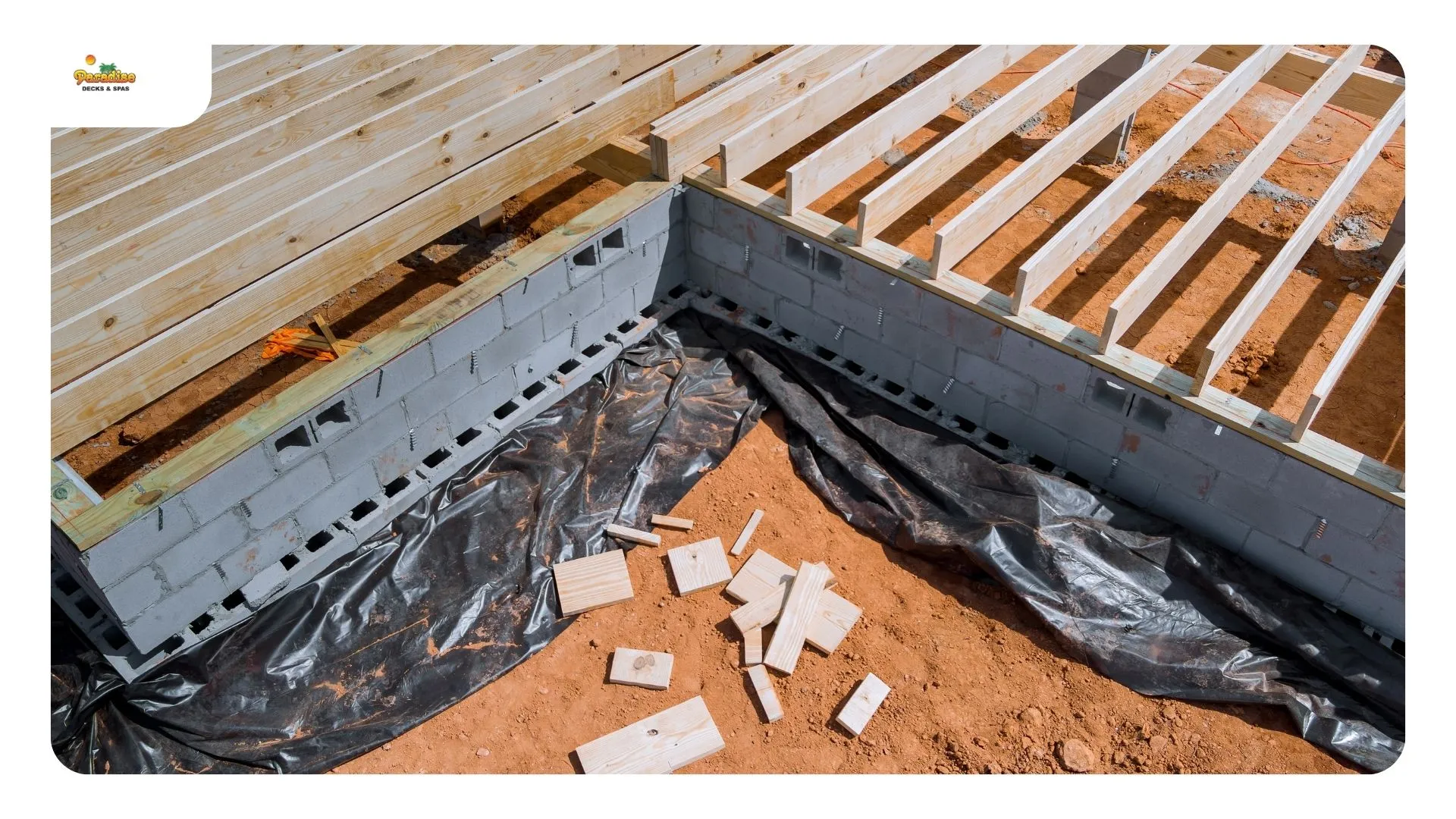
Depth is the wrong question in the north. San Antonio has no meaningful frost line, so nothing forces footings deeper for freeze protection. Up on the limestone, depth is set by reaching sound rock, and once you are bearing on it you are done. Bearing area matters more than depth. That surprises people who have moved here from colder states.
Movement is the whole question in the clay belt. Deep expansive clay swells when it rains and shrinks when it does not, and it does that every year. A deck built on it without accounting for the movement goes out of level, and the first place you see it is a gap opening at the ledger or a stair that no longer meets the landing squarely.
The transition zones are where assumptions cost money. The northeast in particular sits on clayey soil over limestone, which is neither one thing nor the other. That is the one part of town where we will not price footings from a drawing without walking the lot.
One detail that applies everywhere in the city: post bases should hold the wood clear of grade on standoff hardware. Wood sitting directly on concrete wicks water and rots from the bottom up regardless of what the concrete is sitting on.
Two things, and neither is the decking colour. The deck is framed to your lot and your house rather than to a standard rectangle, and features are built into the structure rather than placed on it afterwards.
On flat ground with a straight back wall, the gap between a standard build and a custom one is narrow. On a sloped north-side lot with mature oaks and a drop at the back, the gap is the whole project, because a standard rectangle only fits where the yard is already rectangular.
What custom adds, and what each addition costs structurally, is covered in our guide to custom decks and built-ins — built-in seating, planters, storage, screening and the framing each one needs underneath.
On price: custom runs higher per square foot, because angles, tiers and built-ins take labour a rectangle does not. The total gap is usually smaller than people expect, because a standard deck plus furniture plus a storage box plus a later shade structure often adds up to more than the custom build that included all of it. For real build numbers in this market, our Stone Oak deck construction guide has the cost picture.
Two to four weeks on site for most San Antonio builds, plus permit review before anything starts.
The stage that varies most is the one in the ground, which brings the soil question back round. Drilling footings into limestone on the north side is slow, loud work that can run one to three days depending on how many you need. On the clay side the excavation is faster but the footing design is more involved. Either way it is the first thing that happens and the thing most likely to move the schedule.
The full stage-by-stage sequence, including what happens on each day and what slows jobs down, is in our deck construction stages guide.
Permits sit in front of all of it. Which application applies depends on the deck’s size, height and story count, as San Antonio’s residential deck permit bulletin sets out. We prepare and submit rather than leaving that with the homeowner.
A quote is a scope document, not a number. At minimum it should name:
Two quotes are not comparable if one names the footing approach and the other does not. That is usually where the price difference lives, and it is also the part you cannot inspect once the deck is finished.
We work from our Perrin Beitel showroom and build across the metro, on both sides of the soil line. San Antonio is the core, with Stone Oak and Alamo Heights inside the city, Helotes, Boerne and Bulverde north and west, and Converse and Schertz east, with fourteen communities in total on the full service area list.
Every quote starts with a site visit, because nobody prices footings in this city from a satellite image. Projects run through deck design and deck construction, with the full range on the custom decks page.
How do you choose between deck builders?
Ask what the ground is like at your address and how it changes the footings. A builder who works this city will answer specifically, because the answer differs between the limestone north side and the clay belt. Beyond that: years trading under the same name, current city contractor registration, insurance confirmed by the insurer, a written workmanship warranty, and a reference on a job several years old.
How does soil change the footings from one side of the city to the other?
North of the escarpment the ground is thin soil over Edwards limestone and caliche, so footings are drilled into rock, bear well and barely move seasonally. Through the central clay belt the ground is deep expansive clay that swells and shrinks every year, so footings and post details have to tolerate movement. Transition zones on the northeast and south edges are mixed and should be checked rather than assumed.
How deep do deck footings go in Texas soil?
In San Antonio, depth is set by reaching competent bearing material rather than by a frost line, because there is no meaningful freeze depth here. On the limestone north side that often means shallower and wider than people expect. In the clay belt the design question is movement rather than depth.
What makes a build custom rather than standard, and what does it add?
The deck is framed to your lot and house rather than to a standard rectangle, and features are built into the structure rather than placed on it later. On flat ground the difference is modest. On a sloped lot with oaks and a drop at the back it is the whole project, because a rectangle only fits a rectangular yard.
What should a deck quote spell out before you sign?
Footing approach and count specific to your ground, framing material and joist spacing, decking by brand and line, hardware specification, railing type and height, who pulls the permit, milestone-based payments, stated exclusions, and both the manufacturer and workmanship warranties in writing. Two quotes are not comparable if only one names the footings.
Paradise Decks & Spas
Adress:10615 Perrin Beitel, Suite 604 San Antonio, TX 78217
Phone: (210) 496-3325
Email: info@paradisedecksandspas.com
Hours: Monday to Friday 9:00 AM to 5:00 PM · Saturday 9:00 AM to 4:00 PM · Sunday Closed
Building above ground pool decks across north San Antonio, including Stone Oak, Timberwood Park, Bulverde, Boerne, Helotes, Converse and Schertz.