
Yes — almost any deck will take low-voltage lighting after it’s built. What decides whether that’s a one-day job or an invasive one isn’t the fixtures. It’s whether anyone can reach the framing from underneath. Paradise Decks & Spas retrofits deck lighting across San Antonio, and every quote starts under the deck, not on top of it.
By Rick Hogue, Founder & Lead Deck Specialist · Last updated November 2026
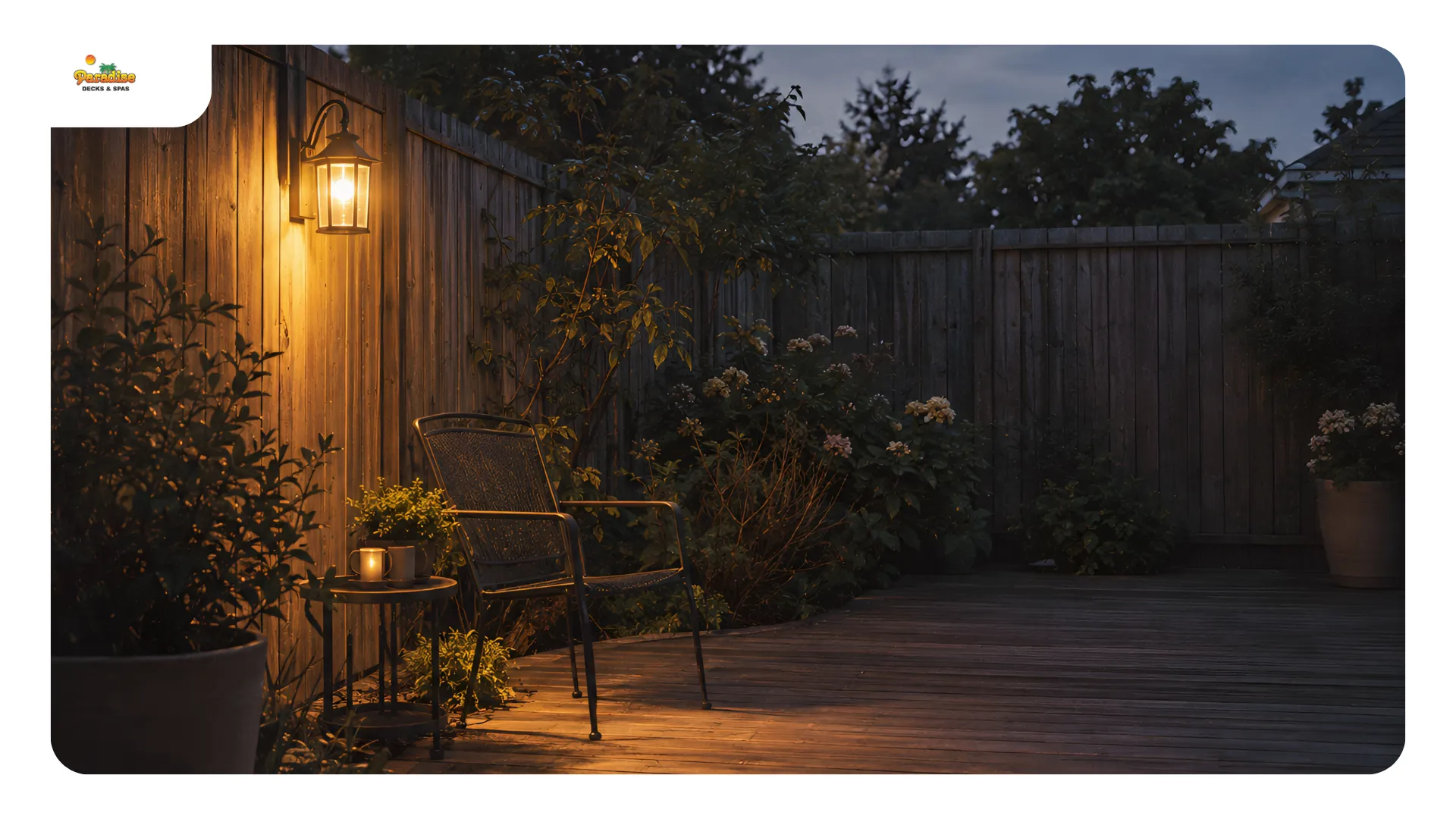
Low-voltage lighting needs a cable from a transformer out to every fixture. On a new build that wire goes in while the frame is open and nobody thinks about it again. On a finished deck, the wire has to get there anyway — and the only question that matters is how it travels.
That makes ground clearance the variable that sets the price, not the fixture count.
Elevated deck with open space underneath. The straightforward version. We work from below, run cable along the underside of the joists, and bore up at each fixture location. Nothing on the walking surface is disturbed, the deck stays usable, and most of these finish in a day. Older elevated decks around Alamo Heights and Terrell Hills usually fall here — the grade drops away behind those houses and there’s real room to work.
Low deck with skirting. Workable, with a step added. Skirting panels come off, we work in the crawl space, then the panels go back. Add a half-day and expect a conversation about whether the skirting will look the same afterward. If it’s older and brittle, sometimes it won’t.
Deck sitting close to grade, no access below. This is where retrofits get invasive, and it’s common on the newer subdivisions out toward Schertz, Cibolo and Converse, where lots are flatter and decks are built low and tight to the ground. With no underside to reach, the options are pulling a run of deck boards to get at the framing, or giving up on recessed fixtures and going to surface and post-mounted lighting instead.
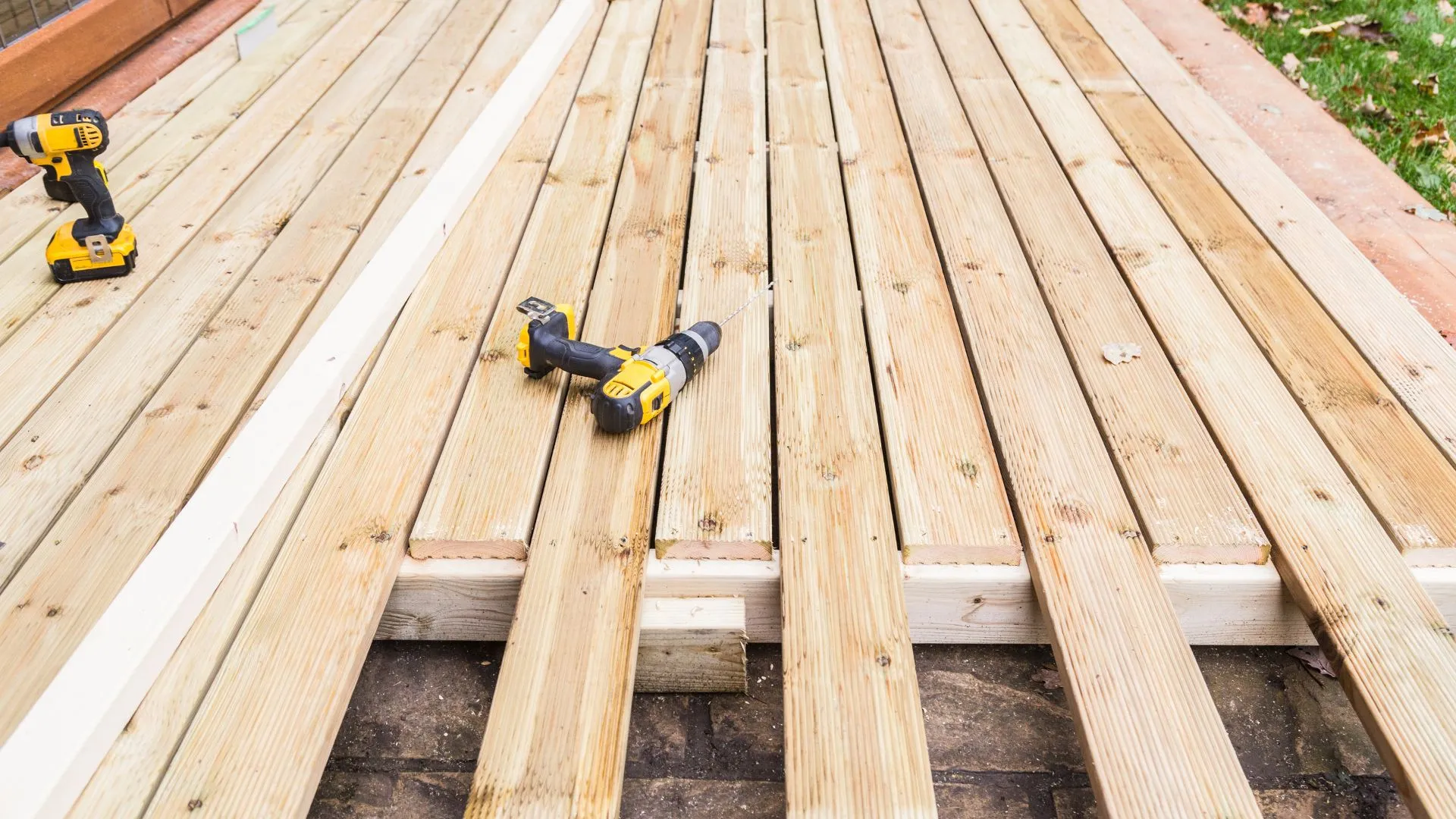
Pulling boards is less dramatic than it sounds when the deck is grooved composite on hidden clips — the clips release from the gap, a board lifts, and it re-sets with no visible evidence. Face-screwed wood is a different conversation: the boards come up fine, but the screw holes don’t go away.
Ground-level deck on sleepers over a slab. The hard case. There’s no cavity at all. Recessed deck-board lighting is effectively off the table, and the honest answer is post-mounted, rail-mounted or integrated perimeter lighting instead.
Two costs hide inside every retrofit regardless of which category you’re in. The first is splices: a retrofit makes more connections than a new build because the cable path has to work around what’s already there, and every splice is a future failure point. The second is the transformer feed, covered further down.
Fixture choice on a retrofit should follow the access you actually have, which is close to the reverse of how people shop for them. Ranked from easiest to hardest to add after the fact:
Post-cap lights. The easiest retrofit by a wide margin. The cap comes off, a hole gets bored down through the post or the cable runs up the back face, and the fixture goes on. No framing access needed at all.
Under-rail and rail-mounted strips. Nearly as easy. The cable hides in the rail channel or behind the top rail, and the whole run stays above the deck surface. These also throw light down onto the deck instead of into your eyes, which matters more than people expect.
Recessed stair riser lights. Moderate. A closed-riser staircase gives you a board to bore through and a cavity behind it, so it works. Open-riser stairs have no riser to recess into — that pushes you to post-mounted fixtures beside the steps or strip lighting under the tread nose.
Recessed deck-board lights. The hardest retrofit, because the hole is in the walking surface and the cable has to arrive from underneath. On an elevated deck that’s routine. On anything low to the ground it’s the fixture type that forces boards to come up.
For which fixture types perform best outdoors in general — housings, IP ratings, smart-controlled systems — our guide to deck lighting installation covers the catalog in full. This post is about getting them onto a deck that already exists.
Light the surface people walk on, not the people walking on it. That single rule settles most placement questions, and getting it wrong is the most common fault we’re called out to correct on existing systems.
On stairs, the fixture belongs low and aimed down — mounted in the riser so it washes the tread below it. The purpose is to make the edge of each step readable. A bright fixture at eye level on a staircase does the opposite: the glare contracts your pupils and the treads go darker than they were before the lights went in. A stair light that makes the stairs harder to see is worse than no stair light, and it’s a surprisingly easy mistake to buy.
Light every tread or light a consistent alternating pattern. Lighting some steps and not others creates exactly the uneven reading that trips people.
On railings, post caps handle perimeter definition — they tell you where the deck ends in the dark, which is their real safety job. Under-rail strips wash the deck floor and do the actual work of making the space usable. Between the two, the strips contribute more usable light and the caps contribute more shape.
The thing to avoid on railings is any fixture that puts a visible bulb in the sightline of someone sitting down. Mount height on a deck is roughly seated eye height, which is why so many rail lights are annoying. Aim down, or hide the source.
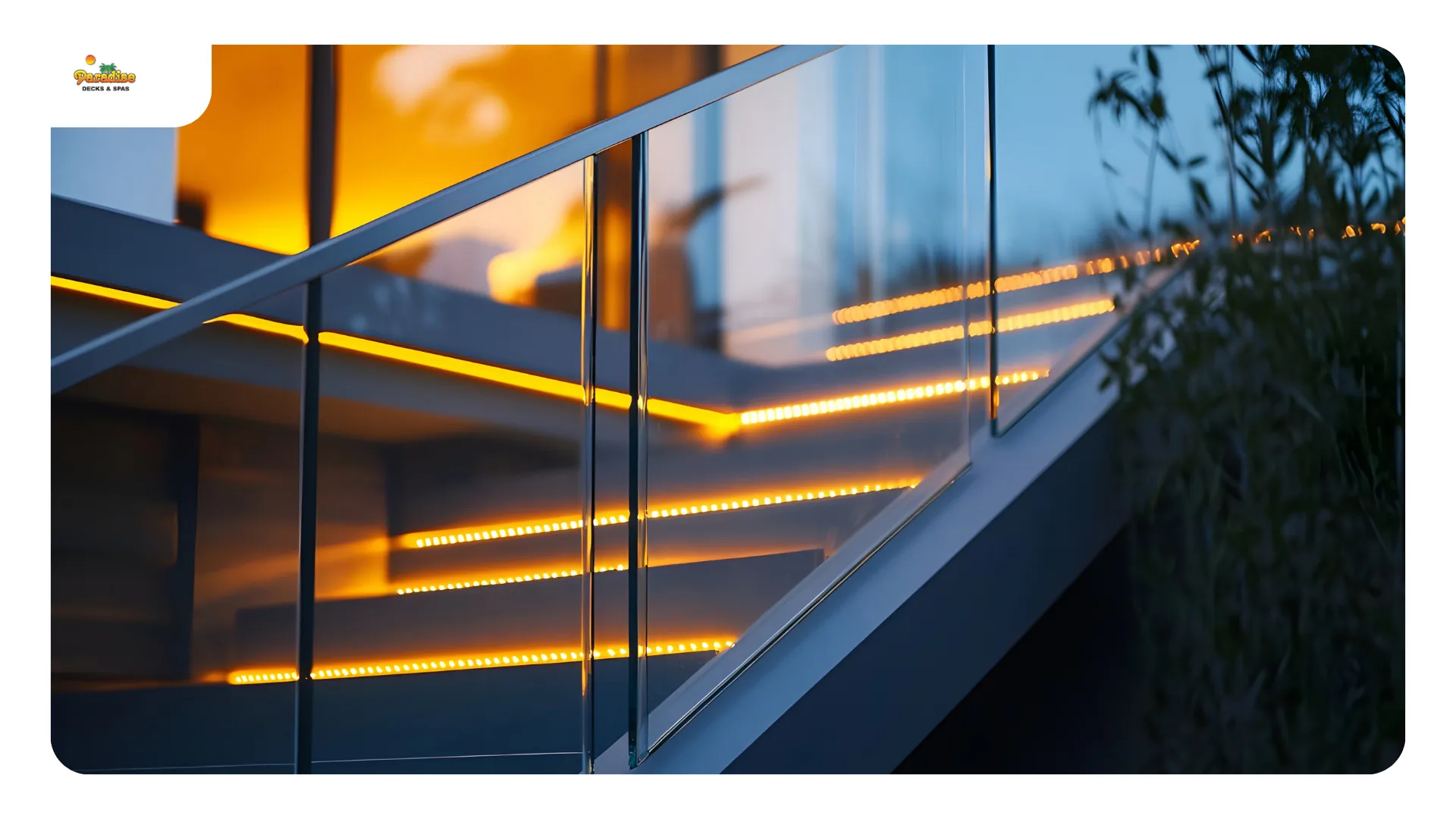
For anything that matters, low voltage. Solar’s single genuine advantage is that it needs no wire, which is exactly the advantage a retrofit is shopping for — so it deserves a straight answer rather than a dismissal.
Where solar earns its place: accent lighting on a deck with no realistic cable path, on posts that get direct sun for most of the day, where nobody minds if the output is modest and uneven.
Where it doesn’t hold up here:
Never solar on stairs. Stair lighting is a safety function, and a safety function has to work at full output every night, not at whatever charge the battery managed that afternoon.
Ratings matter and are well covered elsewhere — wet-rated fixtures on open deck surfaces and risers, damp-rated at minimum under a cover. What’s specific to retrofits is that the failures usually aren’t the fixtures at all. They’re the three things a retrofit adds.
Connections. A retrofit makes more splices than a new build, and water finds every one of them. Twist-on wire nuts are not an outdoor connection no matter how much tape goes around them — gel-filled or heat-shrink connectors are, and that difference is most of the reason retrofit systems fail at year three while the fixtures are still fine.
Voltage drop. On a retrofit the cable rarely gets to take the direct route, so runs end up longer than they’d be on a new build. At 12 volts, distance costs you real voltage, and the fixtures at the end of a long daisy chain read dimmer and warmer than the ones near the transformer. Homeowners read that as a bad fixture. It isn’t. The fixes are heavier-gauge cable, a hub layout that feeds branches from a central point rather than one long chain, or a multi-tap transformer that sends a higher voltage down the long leg.
The transformer feed. The transformer needs a GFCI-protected exterior outlet. If there’s one within reach, you’re fine. If there isn’t, adding one is electrical work — and in Texas, anyone performing electrical work must be licensed through the Department of Licensing and Regulation, with a limited set of exemptions listed on their site. This is the item most likely to move a retrofit quote, and it has nothing to do with the lights.
Mount the transformer in shade where you can, and never boxed in. It’s the one component on the system that generates its own heat, and summer here gives it no help.
Paradise Decks & Spas adds lighting to existing decks throughout the San Antonio metro. Northeast toward Schertz, Cibolo, Converse and Universal City, the lots run flatter and the decks sit lower, so access is the first thing we check and post-and-rail fixtures come up more often than recessed. Closer in around Alamo Heights and up through Stone Oak, more decks are elevated with usable space underneath, which opens up riser and deck-board lighting without pulling a single board.
We also cover Live Oak, Helotes, Boerne, Bulverde, New Braunfels, Canyon Lake, Bandera and Lake Medina. The full list lives on our service areas page.
Can lighting be added to a deck that is already built?
Yes, on nearly any deck. The difficulty is set by access to the framing underneath, not by the fixtures. An elevated deck with open space below is typically a one-day retrofit with nothing disturbed on the surface. A deck sitting low to the ground with no underside access means either pulling a run of deck boards or switching to post-mounted and rail-mounted fixtures instead of recessed ones.
What holds up to Texas heat and storms?
Wet-rated fixtures on open surfaces and risers, damp-rated at minimum under a cover. On retrofits specifically, the failures are usually the connections rather than the fixtures — use gel-filled or heat-shrink connectors, never taped wire nuts. Mount the transformer in shade and leave it room to breathe, since it’s the one component making its own heat.
Where should lights go for stairs and railings?
Low and aimed down. Stair fixtures belong in the riser so they wash the tread below, making each step edge readable. A light at eye level on a staircase causes glare and makes the steps harder to see than before. On railings, post caps define the perimeter and under-rail strips wash the deck floor — avoid anything that puts a visible bulb at seated eye height.
Low voltage or solar?
Low voltage for anything that matters. Solar’s only real advantage is needing no wire, and it’s paid for in heat-killed batteries, panels starved by the shade a good deck has on purpose, output that fades through the evening, and fixtures that can’t be dimmed, zoned or switched together. A row of solar caps looks visibly uneven within a year. Never use solar for stair lighting.
How much does lighting add to a build?
On a new build, very little — the wire goes in while the frame is open, so you’re paying for fixtures and a transformer. On a retrofit, the cost sits in two places that have nothing to do with the lights: the labor to reach the framing, and adding a GFCI outlet for the transformer if one isn’t already in reach. Our deck lighting installation guide has the full system-by-system pricing.
Paradise Decks & Spas
Adress:10615 Perrin Beitel, Suite 604 San Antonio, TX 78217
Phone: (210) 496-3325
Email: info@paradisedecksandspas.com
Hours: Monday to Friday 9:00 AM to 5:00 PM · Saturday 9:00 AM to 4:00 PM · Sunday Closed
Building above ground pool decks across north San Antonio, including Stone Oak, Timberwood Park, Bulverde, Boerne, Helotes, Converse and Schertz.