
Less often because of the soil than most people assume. Stone Oak sits on limestone and caliche rather than the expansive clay that moves slabs elsewhere in San Antonio, so cracking here usually traces back to how the slab was poured, cured and jointed. Paradise Decks & Spas pours concrete pool surrounds across north San Antonio, and crack control is a detailing problem before it is a soil problem.
By Rick Hogue, Founder & Lead Deck Specialist · Last updated October 2026
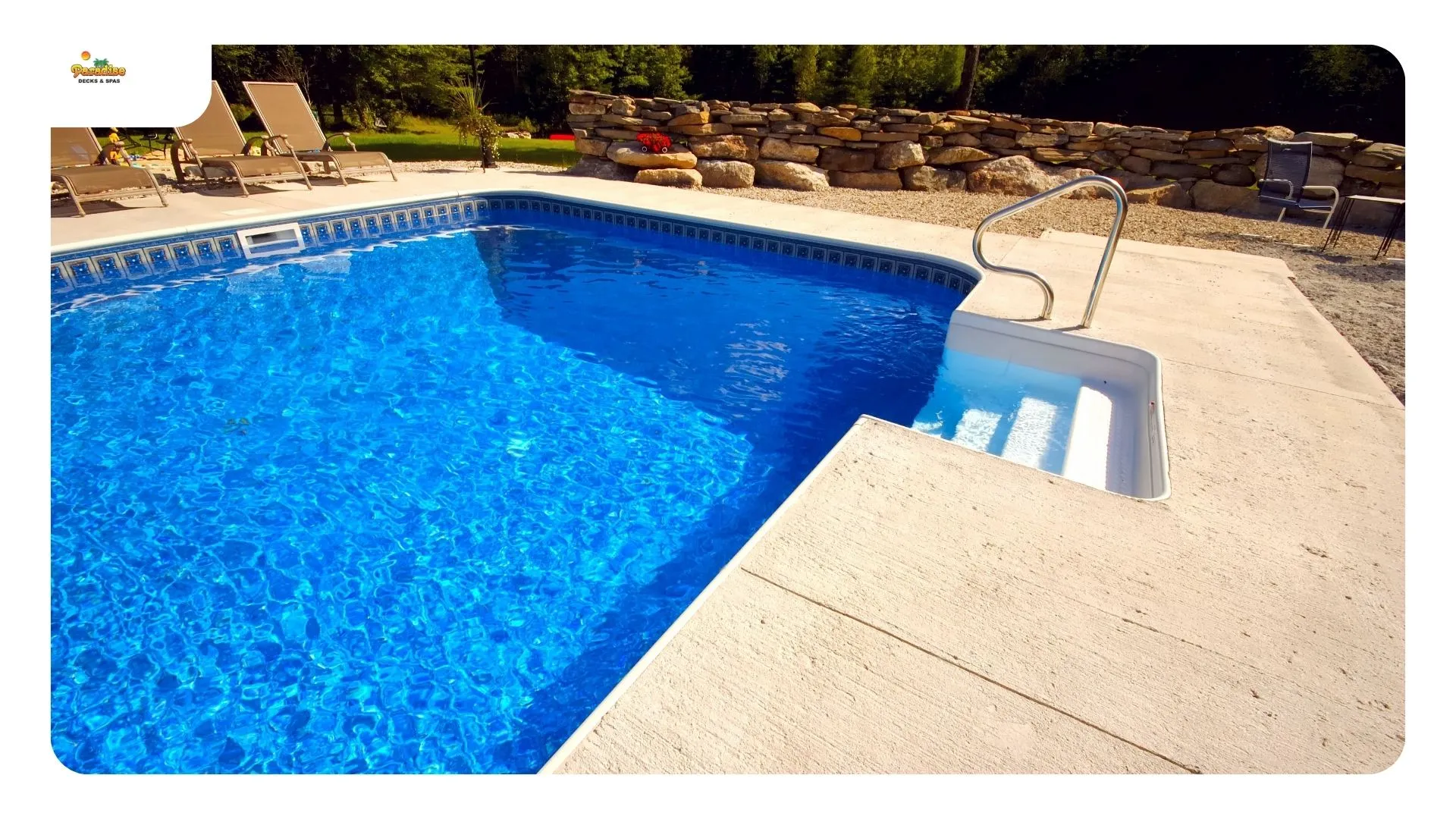
All concrete cracks. The honest framing is not whether it cracks but whether the cracks land where someone put them. Four causes account for nearly everything we see on Stone Oak pool decks, and only one of them is the ground.
Pouring into summer heat. This is the big one locally, and it is entirely avoidable. Concrete poured on a 100 degree afternoon with wind and low humidity loses surface water faster than it can bleed, and the surface shrinks while the body below is still plastic. The result is plastic shrinkage cracking, usually short random cracks visible within hours. Pouring early in the day, using an evaporation retardant, and wet curing or cure sealing for a full seven days prevents it. A crew in a hurry on a July afternoon does not.
Joints in the wrong places, or missing. Drying shrinkage is unavoidable as the slab cures. Joints give that shrinkage somewhere to go. Too few joints, joints cut too shallow, or joints cut too late, and the slab picks its own crack lines instead.
The pool itself. A pool shell is a rigid structure and the slab shrinks away from it. If the slab is poured hard against the coping with no isolation, the crack forms at the pool edge, which is the worst possible place for it.
Fill, where there is fill. Here is the Stone Oak nuance. Rock bearing is excellent, and that is why slabs on this side of town generally outperform slabs on the clay south and east of the city. But plenty of Stone Oak lots are terraced cut and fill pads. The cut side is sitting on rock. The fill side is sitting on engineered fill that can still settle. A pool deck spanning both can crack along the line between them if the subgrade was not properly compacted and the slab was not reinforced to handle it.
So when a competitor tells you San Antonio clay cracked your Stone Oak pool deck, be sceptical. Up here it is usually the pour.
Four things, and none of them are optional on a pool surround.
Contraction joints at proper spacing and depth. Industry guidance from the American Concrete Institute and the National Ready Mixed Concrete Association puts maximum joint spacing at roughly 24 to 36 times slab thickness, which works out to about 10 feet on a 4 inch slab and a hard ceiling around 15 feet, with joints cut to a quarter of the slab thickness. The NRMCA jointing guidance sets out the detail. Cut too shallow and the joint never activates, which means the slab cracks somewhere else instead.
An isolation joint at the pool. Separate, and different from a contraction joint. The slab has to be free to move independently of the pool structure, so a compressible isolation material runs the full perimeter at the coping. This single detail prevents the most common and most visible failure on a pool surround.
Reinforcement sized to the job. Fiber mesh helps with plastic shrinkage but does little for structural crack width. Welded wire or a rebar grid, properly positioned in the upper middle of the slab rather than lying on the subgrade, is what holds a crack tight if one forms. On a fill pad, rebar rather than mesh.
Thickness and subgrade. Four inches minimum for a pool surround, more where vehicles or heavy features land. Compacted subgrade underneath, which matters far more on the fill side of a terraced lot than on the rock.
A reasonable question to ask any contractor quoting your surround: where are the joints going, how deep, and what is at the pool edge. A good answer is specific. A vague one tells you something.
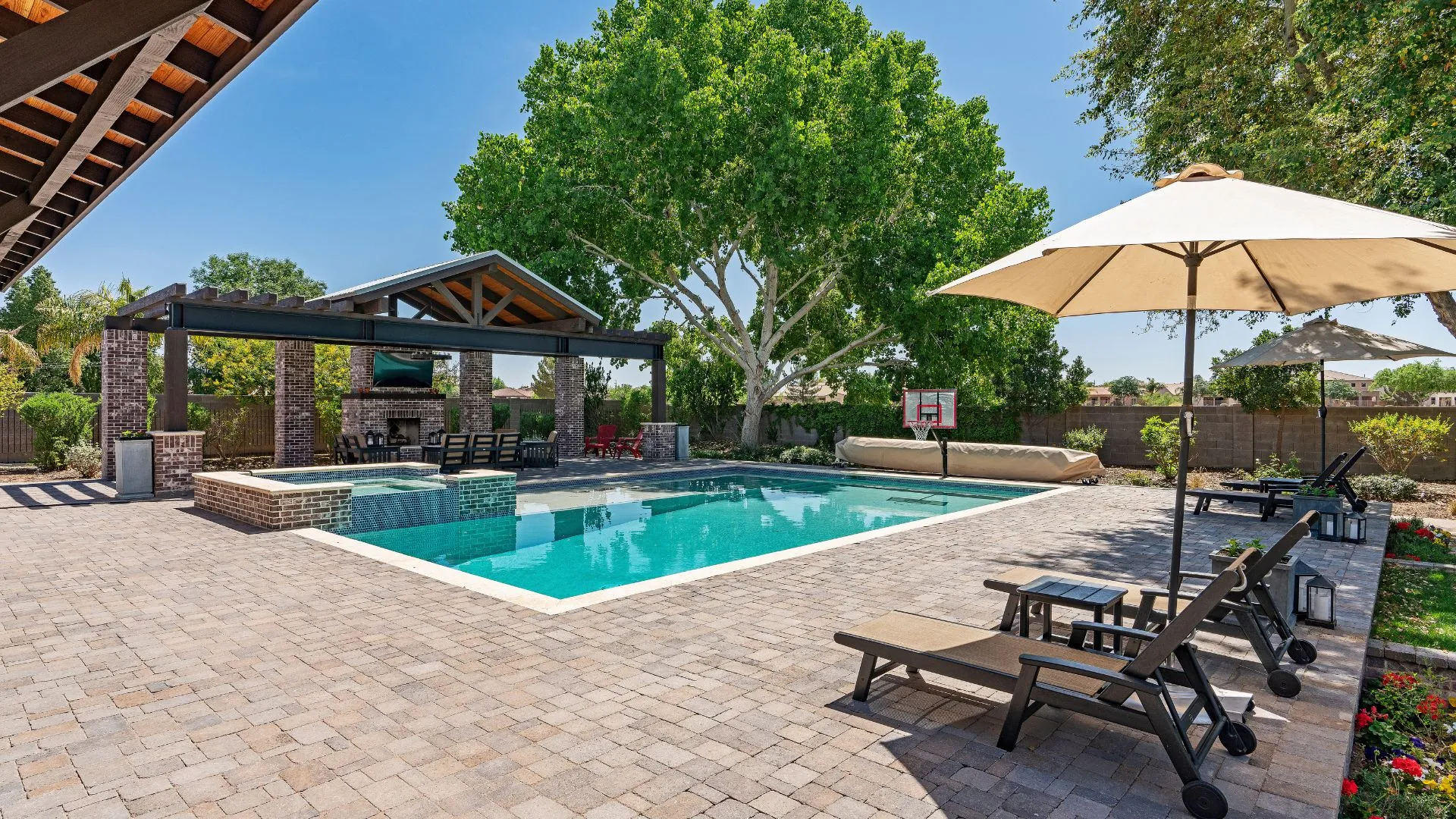
Control joints and a perimeter isolation joint on a concrete pool deck in north San Antonio
| Finish | Wet traction | Heat underfoot | Cost per sq ft | Hides cracks |
|---|---|---|---|---|
| Broom finish | Very good | Moderate, color dependent | $8 to $15 | Poorly |
| Exposed aggregate | Excellent | Moderate | $10 to $18 | Well |
| Salt finish | Good | Moderate | $9 to $16 | Moderately |
| Stamped and sealed | Poor if glossy sealed | Warm to hot | $12 to $22 | Very well |
| Acrylic lath cool deck overlay | Good, textured | Cool | $6 to $12 over sound concrete | Well |
For a pool surround specifically, broom finish and exposed aggregate are the safe answers, and exposed aggregate has the useful side effect of camouflaging any hairline cracking that does appear. Broom finishing should run across the direction people walk rather than along it.
Stamped concrete is where pool decks most often go wrong. The pattern looks excellent and the glossy film sealer that makes it look that way is what turns a wet surface slick. If you want stamped around a pool, the sealer needs a grit additive mixed in, no exceptions. We would rather leave a surround unsealed than seal it slick.
A light color does more for comfort than any finish choice. That holds across every option in the table.
Hot enough to matter, and color decides more than material does. Dark concrete in full sun can reach a surface temperature that ends barefoot use in the afternoon, while a light toned slab runs substantially cooler in the same yard on the same day. An acrylic lath cool deck overlay drops it further still.
Our pool deck installation guide compares surface temperatures across all the common materials, including travertine and pavers, if you are still choosing between them rather than committed to concrete.
Most Stone Oak concrete surrounds run $5,000 to $16,000, based on a typical 600 to 900 square foot surround.
Add for demolition of an existing slab, for drainage work, and for retaining where a terraced lot falls away. If the existing slab is cracked through rather than surface worn, an overlay will not fix it, because the crack reflects back through.
Different failure modes rather than a clear winner.
Concrete is monolithic, which is its strength and its weakness. Properly jointed and cured on rock, a concrete surround lasts decades with very little attention. But any crack is permanent and any repair is visible, because new concrete never matches old.
Pavers flex. Individual units move slightly with the ground instead of cracking, and a damaged or stained one lifts out and gets replaced invisibly. The trade is maintenance: joint sand needs topping up, and sections settle over time and need re-leveling, especially on fill.
On Stone Oak’s rock, concrete’s main disadvantage largely disappears, which is why we pour a lot of it here. On a fill pad, or where impervious cover is tight, pavers set with permeable joints are often the better answer. Our Stone Oak decking company guide covers how the Edwards Aquifer Recharge Zone overlay affects that choice.
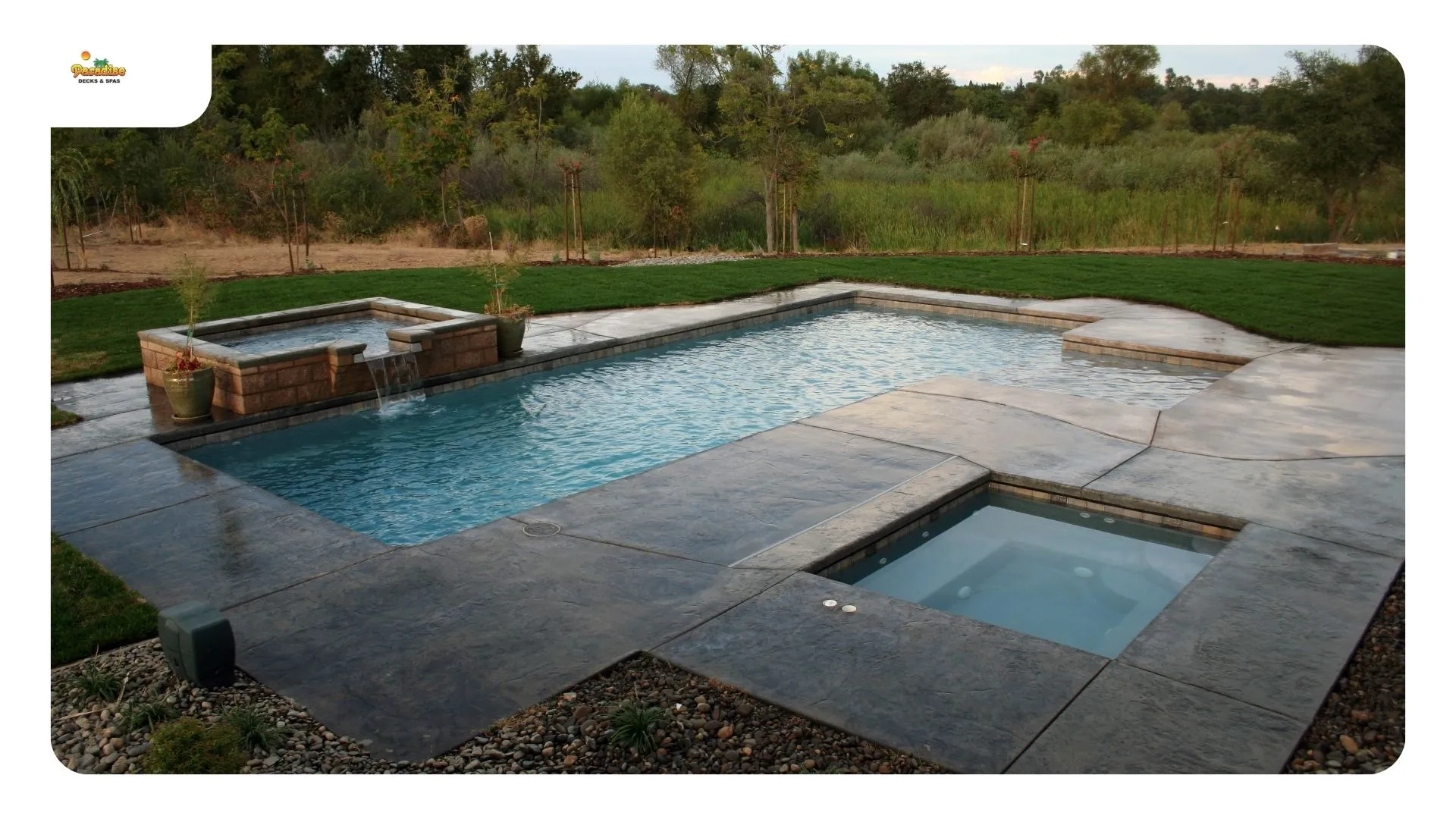
We work out of our Perrin Beitel showroom and pour across Stone Oak on both sides of 281, including Sonterra, the TPC Parkway corridor, the neighborhoods near Stone Oak Park, and north toward Timberwood Park. Every quote starts with what is under the slab: rock or fill, existing surround or bare ground, and where the pool structure sits relative to where joints need to land.
See the Stone Oak service area page for everything we do locally. We also work in Bulverde, Boerne, Helotes and Alamo Heights, with fourteen communities on the full service area list. Hardscape sits alongside our outdoor living work, and if a raised deck is going in beside the surround, deck construction runs on the same schedule.
Stamped concrete pool deck with a textured sealer finish in north San Antonio
How hot does bare concrete get around a San Antonio pool?
Hot enough to end barefoot use on a summer afternoon, with color the deciding factor rather than the material. A light toned slab runs substantially cooler than a dark one in the same yard on the same day, and an acrylic lath cool deck overlay drops it further.
Why does concrete crack around pools in this soil?
In Stone Oak, usually not because of soil. The ground here is limestone and caliche rather than the expansive clay that moves slabs elsewhere in San Antonio. The common causes are pouring into afternoon heat without proper curing, joints cut too shallow, too late or too far apart, no isolation joint at the pool coping, and settlement where a terraced lot’s fill side was not properly compacted.
Stamped, broom or exposed aggregate: which finish suits a pool?
Broom finish and exposed aggregate are the safe answers, with exposed aggregate having the advantage of hiding hairline cracking. Broom should run across the direction of travel. Stamped looks best and performs worst around water, because the glossy sealer that brings out the pattern makes a wet surface slick, so it needs a grit additive in the sealer.
What does a concrete pool deck cost?
Most Stone Oak surrounds run $5,000 to $16,000 for a typical 600 to 900 square foot area. Broom finish is roughly $8 to $15 per square foot installed, exposed aggregate $10 to $18, stamped $12 to $22, and a cool deck overlay on sound existing concrete $6 to $12. Demolition, drainage and retaining are extra.
Does concrete or pavers hold up longer in this climate?
They fail differently. Concrete on Stone Oak rock lasts decades with little attention, but any crack is permanent and repairs never match. Pavers flex with ground movement instead of cracking and individual units replace invisibly, at the cost of topping up joint sand and re-leveling settled sections. On rock, concrete. On fill or where impervious cover is tight, pavers.
Paradise Decks & Spas
Adress:10615 Perrin Beitel, Suite 604 San Antonio, TX 78217
Phone: (210) 496-3325
Email: info@paradisedecksandspas.com
Hours: Monday to Friday 9:00 AM to 5:00 PM · Saturday 9:00 AM to 4:00 PM · Sunday Closed
Building above ground pool decks across north San Antonio, including Stone Oak, Timberwood Park, Bulverde, Boerne, Helotes, Converse and Schertz.