
Choosing wood deck materials San Antonio TX homeowners build with means accepting one upfront reality. Wood requires more maintenance in our climate than it does in mild-weather states. That’s because San Antonio’s UV intensity, summer heat, and humid shoulder seasons put real stress on any natural material. Paradise Decks and Spas is a licensed and insured San Antonio deck contractor. We help homeowners choose and build with wood materials suited to South Texas conditions.
By Rick Hogue, Founder & Lead Deck Specialist · Last updated 15 June 2026
Wood is still one of the most popular deck surface choices in San Antonio. It’s familiar, workable, and carries a natural warmth no manufactured material quite matches. However, “wood deck” covers a wide range of options that perform very differently under our conditions. So this guide covers the main wood choices for San Antonio decks, what they cost, how they compare, how to protect them, and how long they realistically last here.
As an alternative to wood maintenance, see our composite deck materials guide. For our full deck services, see our deck construction page.
Homeowners often ask what wood deck material is best for San Antonio TX heat. The answer depends on the trade-off between upfront cost, maintenance commitment, and lifespan. Here’s how the main options perform in our climate.
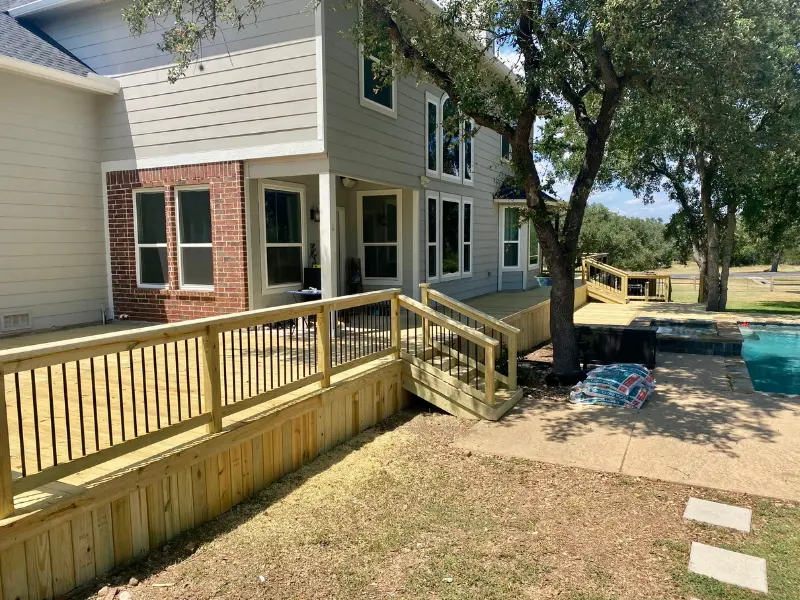
PT pine is the most common wood deck surface in San Antonio and across Texas. It’s chemically treated to resist rot and insects, which are two real concerns in our humid summers. It’s also the most affordable natural wood option. However, PT pine requires regular sealing every one to two years in our climate. Otherwise, UV bleaching and moisture-induced cracking accelerate. Properly maintained, though, it’s durable and cost-effective.
Cedar is the premium natural wood choice for San Antonio decks. Its natural oils resist rot and insects without chemical treatment. It’s also more dimensionally stable than PT pine in temperature extremes. Notably, cedar stays cooler to the touch than PT in direct Texas sun, which matters on a south- or west-facing deck. It costs more than PT. Even so, it requires similar periodic sealing to hold up in our UV environment.
Species such as ipe (Brazilian walnut), tigerwood, and mahogany make up the premium tier. Dense tropical hardwoods resist rot, insects, and UV naturally, with lifespans of 25–50 years under minimal treatment. They’re expensive and harder to work with. Even so, they’re genuinely the most durable natural option for hot, humid climates like South Texas.
How much do wood deck materials cost in San Antonio? That depends on species and grade. Here’s a 2026 material cost guide for the area.
Wood material | Material cost (per sq ft) | Installed cost (per sq ft) |
Pressure-treated pine | $2 – $5 | $15 – $30 |
Cedar | $4 – $9 | $25 – $42 |
Redwood | $6 – $12 | $30 – $50 |
Hardwood (ipe, tigerwood) | $8 – $20 | $35 – $65 |
Material cost is only part of the picture. Wood decks also carry ongoing maintenance costs that composite avoids, including sealer or stain every 1–2 years plus periodic board replacement. As a result, the 20-year total cost of ownership for a PT wood deck often approaches that of a composite deck.
The pressure treated vs cedar deck materials for Texas question is the one most San Antonio homeowners face when choosing wood, since these two options dominate the local market. Here’s the direct comparison.
The pressure treated wood decking San Antonio homeowners use most is PT pine, the budget-smart choice. It costs less upfront, it’s widely available, and chemical treatment makes it rot and insect resistant. It’s also proven in our climate. There are Texas-specific downsides, though. It can hold more heat than cedar, since PT often starts with a darker, greener color that absorbs it. Additionally, it can take a few months to dry fully after installation before staining. Left unsealed, it also warps and cracks faster than cedar.
For cedar deck materials Bexar County TX homeowners choose for premium builds, the cost runs 30–50% more than PT upfront. In return, cedar delivers better dimensional stability in our heat. Its cell structure resists the expansion and contraction our summer-to-winter swings cause. Meanwhile, its natural oils make it more insect-resistant without chemical treatment, and it stains beautifully. So if you’re willing to spend 30–50% more on materials, cedar is the better long-term wood for San Antonio’s conditions.
For framing and structural lumber, pressure-treated is the right choice regardless of your surface boards. Structural elements need the rot and insect protection PT provides, particularly at ground contact.
The hardwood decking options San Antonio Texas homeowners consider most often break down as follows. One premium alternative worth knowing about isn’t technically a hardwood, and we’ve noted it separately below.
Ipe is the most popular premium hardwood deck material. It’s extremely dense and resistant to rot, insects, fire, and UV, with a natural lifespan of 25–50 years. However, it’s hard to cut and fasten, so it requires pre-drilling. It’s also expensive. Additionally, it needs annual oiling to keep its rich brown color. Without oiling, it weathers to silver-gray instead, which some homeowners actually prefer. For a long-term investment deck in South Texas, ipe is the material you never have to replace.
These are similar tropical hardwoods with comparable performance, sometimes at lower cost than ipe.
Redwood is technically a softwood rather than a hardwood, so it’s softer than ipe. Still, it belongs in this comparison. It’s naturally rot-resistant, attractive, and easier to work with. It also performs better in our climate than PT or cedar, without the price and workability challenges of tropical hardwoods. However, West Coast availability can affect Texas pricing.
Ultimately, hardwood is the choice for homeowners building once and not wanting to think about the deck for decades. For most San Antonio budgets, though, PT or cedar remains the practical decision.
Protecting wood from San Antonio’s conditions means addressing four threats. UV radiation bleaches and degrades the surface. Moisture creates the conditions for rot and mold. Heat drives expansion and cracking. Finally, insects matter here, since termites are a real concern in South Texas. Here’s the protection strategy.
For cedar decking Universal City TX homeowners and others across the region, the same protocol applies. Cedar’s natural oils help, but they don’t eliminate the need for UV protection in our sun.
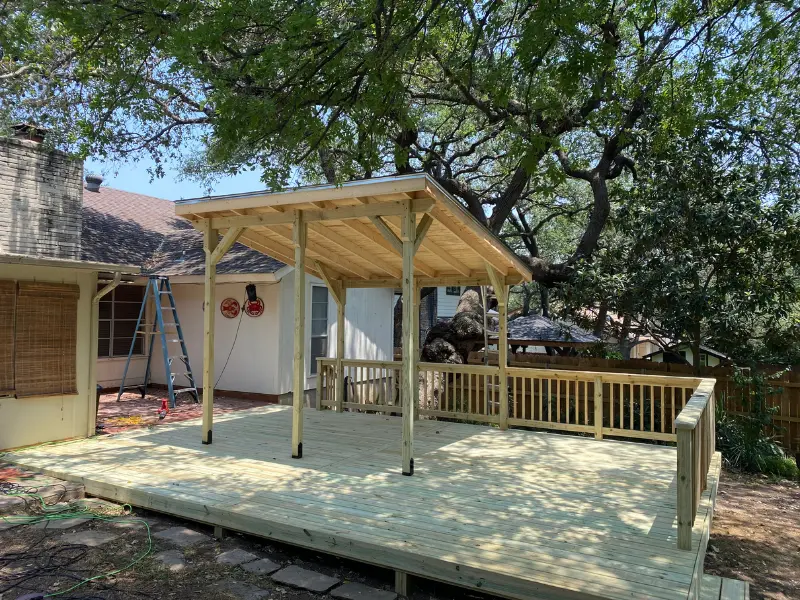
This is where the honest math matters. In San Antonio’s climate, pressure treated lumber deck Bexar County TX boards typically last 10 to 15 years on the surface with regular maintenance before individual boards need replacing. Full replacement often comes at 15 to 20 years. Cedar extends that to 15–20 years on the surface with good care. Meanwhile, tropical hardwoods can go 25–50 years without replacement.
The key word is maintenance. A PT deck sealed on schedule and inspected for rot will reach 15–20 years. By contrast, one neglected for three or four years in our climate shows significant deterioration in half that time. That’s because South Texas combines UV intensity with periodic high humidity, and together they’re harder on wood than either factor alone.
Paradise Decks and Spas helps homeowners choose the right wood material for their budget, usage, and maintenance commitment. We serve the following areas.
We build with both wood and composite. So we help you choose honestly, based on your situation rather than ours.
Tropical hardwoods like ipe and tigerwood last the longest — 25 to 50 years with minimal maintenance in San Antonio conditions. Cedar is next at 15 to 20 years with regular sealing. Pressure-treated pine typically lasts 10 to 15 years on deck surfaces with consistent maintenance before boards need significant replacement. All wood lifespans shorten significantly without regular sealing in San Antonio’s UV and humidity.
In 2026, wood deck material costs in San Antonio run $2 to $5 per square foot for pressure-treated pine, $4 to $9 for cedar, $6 to $12 for redwood, and $8 to $20 for tropical hardwoods like ipe. Installed costs including labor run $15 to $30 for PT and $35 to $65 for hardwoods. Factor in ongoing maintenance costs (sealer every 1–2 years) when comparing wood to composite over the full lifespan.
Yes — with regular maintenance. Pressure-treated pine is the most common deck surface in San Antonio for good reason: it’s affordable, rot and insect resistant, and proven in our climate. The commitment is sealing every one to two years to prevent UV cracking and moisture damage. Without regular sealing in South Texas conditions, PT deteriorates faster than in milder climates. For framing and structural members, PT is the right choice regardless of the surface board material.
Apply a penetrating oil-based stain with UV inhibitors annually or biennially — this is the single most important step. Choose lighter stain colors to reduce surface heat absorption. Keep the deck surface clean to prevent mold and algae buildup in shaded areas. Check and re-fasten loose boards annually since Texas temperature swings work on fasteners over time. Maintain drainage clearance under the deck so boards aren’t in contact with standing water.
Pressure-treated wood deck surfaces in San Antonio typically need individual board replacement after 10 to 15 years and full deck surface replacement at 15 to 20 years with regular maintenance. Cedar extends that to 15 to 20 or more years. Tropical hardwoods can last 30 to 50 years. In all cases, South Texas’s UV intensity and humidity make regular sealing essential — neglected wood deteriorates significantly faster here than in milder climates.
Paradise Decks and Spas San Antonio, TX Phone: (210) 496-3325 Email: info@paradisedecksandspas.com
Serving San Antonio and the surrounding Bexar County area, including Universal City, Helotes, Converse, Schertz, Cibolo, Alamo Heights, and Boerne.
Request a free wood deck consultation or call (210) 496-3325.