
Paradise Decks & Spas builds pergolas across San Antonio in cedar and powder-coated aluminum, attached to the house or freestanding. We’ve been doing it since 2006, we pull the permits, and we’ll be straight with you about how much shade you’ll actually get — which is the question most pergola pages avoid.
By Rick Hogue, Founder & Lead Deck Specialist · Last updated September 2026
The words get used interchangeably. They shouldn’t be, because the difference changes your permit, your budget, and what the structure does for you.
A pergola has an open roof — rafters and slats with gaps between them. It filters sunlight, defines the space, supports climbing plants or a retractable canopy, and lets rain straight through.
A patio cover has a solid roof. Full shade, rain protection, and the option of a ceiling fan or recessed lighting underneath. It also blocks light into any room behind it, which is a real consideration on a south-facing wall.
A louvered pergola sits between them: adjustable slats you rotate from open to closed. Full shade when you want it, sun when you don’t, and most systems close tight enough to shed a shower. It costs roughly two to three times a fixed cedar pergola.
Which you want comes down to one question: do you need shade, or do you need shelter? If you want to sit outside during a July thunderstorm, you need a cover. If you want a space that feels open and breathes in the evening, you want a pergola.
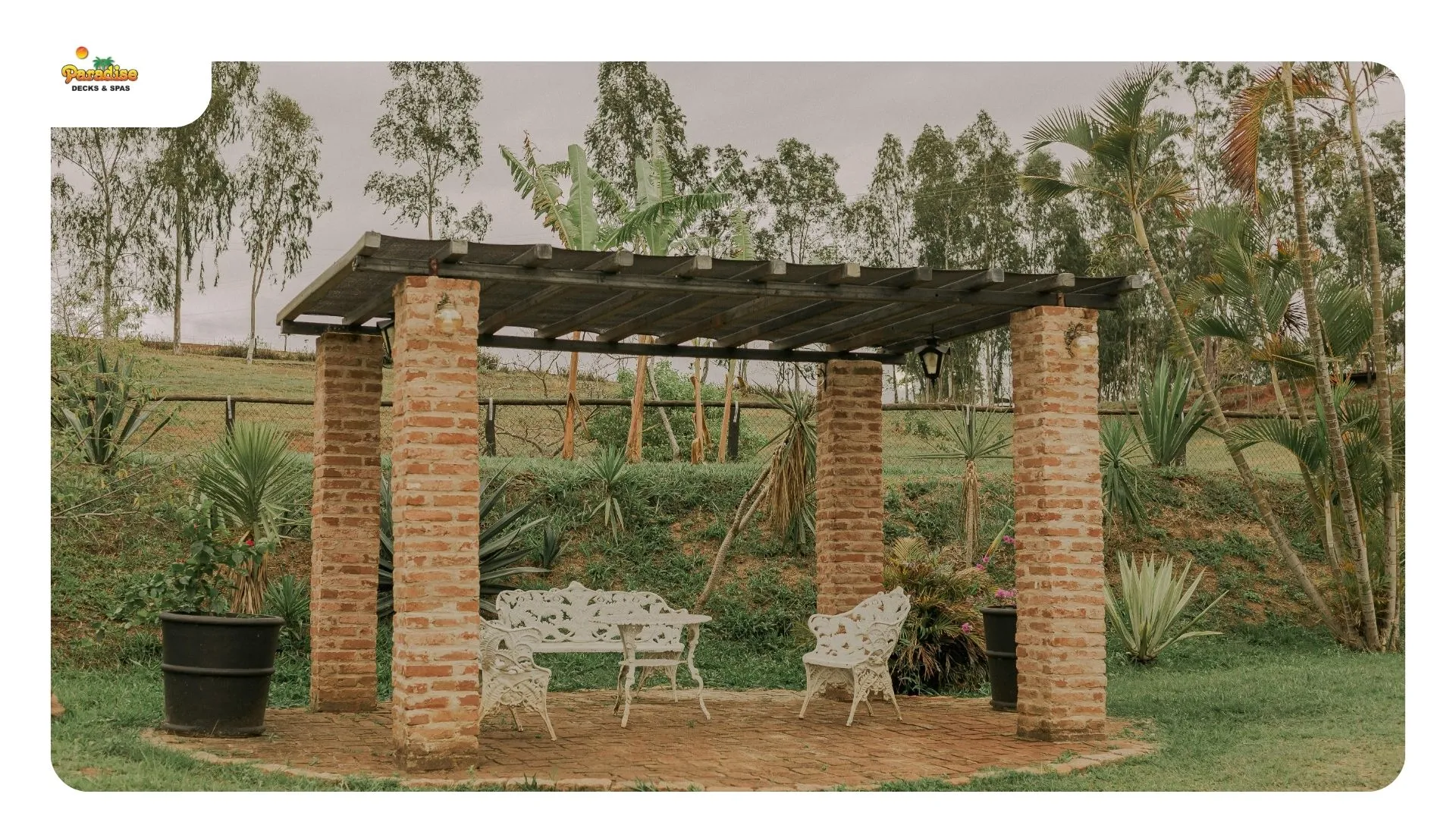
Honestly? A standard fixed-slat pergola gives roughly 40 to 60% shade at midday, and close to nothing at 6 PM. That second half is the part that matters in San Antonio, and almost nobody tells you.
Here’s the geometry. San Antonio sits at about 29.4° north latitude, so at noon in late June the sun is roughly 84 degrees above the horizon — nearly straight overhead. Slats cast their shadow almost directly downward, and coverage is at its best. By late afternoon the sun has dropped low in the west and comes in sideways, under the structure entirely. Your slats are shading the rooftop and nothing else.
Since 4 to 7 PM is exactly when most people want to be outside here, that’s the problem to design around rather than discover.
What actually moves the number:
If full afternoon shade is the actual goal, we’ll tell you a pergola alone won’t get you there. Sometimes the right answer is a patio cover or screen room instead, and we’d rather say that at the estimate than after.
This is where the decision stops being aesthetic. The City of San Antonio sets the threshold clearly on its own residential improvements application:
A patio or porch cover requires a permit when it is more than 300 square feet, OR when it is attached to the dwelling.
Read that again — attached triggers a permit at any size. A modest 12×12 pergola bolted to your house needs one; the same pergola standing on its own four posts, under 300 square feet, generally doesn’t.
Setbacks, per the city’s application: front 10 feet, side 5 feet, rear 20 feet if attached, 5 feet if detached. Structures are limited to one story and 12 feet in height.
There’s a useful wrinkle in the Unified Development Code: in residential districts, an accessory structure with no eaves, cornices, or similar projecting features may sit as close as three feet from a side or rear property line. A clean open pergola often qualifies where a covered structure with overhangs wouldn’t — which can be the difference between fitting in a narrow yard and not.
Inspections on a permitted structure run differently than on a deck. Expect a framing inspection and a final, plus a letter of inspection from a licensed foundation engineer on file at completion. Budget for that up front; it surprises people.
Two more things worth knowing:
Attachment point. An attached pergola ties into the roof fascia or wall band, and that penetration is where leaks start if it’s flashed carelessly. It’s a five-minute detail that causes five-figure problems.
Solar pergolas have their own bulletin. If you’re planning to mount a PV array on the structure, San Antonio treats it under Information Bulletin 405, and foundations supporting a solar array require engineered plans from a Texas-licensed engineer. Tell us at the estimate if solar is even a maybe — retrofitting a pergola that wasn’t designed for the load isn’t practical.
Outside city limits the rules change again. Helotes, Boerne, and Bulverde administer their own; unincorporated Bexar and Comal County follow different thresholds. We confirm jurisdiction before we design.
Western Red Cedar. The classic look, naturally rot and insect resistant, and the warmest material to sit under. The honest caveat for this climate: cedar checks and cracks in our heat and UV, and it needs sealing every two to three years to stay looking its best. Beautiful, but not maintenance-free.
Powder-coated aluminum. No warping, no cracking, no sealing, and it spans further than timber — so fewer posts and a cleaner look over a large patio. It costs more up front and reads more contemporary. For most full-sun San Antonio installations it’s the material we’d point you toward.
Pressure-treated pine. The budget route. Structurally sound and paintable, but it moves more than cedar and wants painting or staining on a cycle.
Vinyl and fiberglass. Low maintenance, limited color and span options, and fiberglass in particular handles long spans well.
Louvered aluminum systems. Motorized or manual adjustable blades. The premium option, and the only one that genuinely solves shade on demand.
If you’re going with cedar or pine, our deck staining crew handles the sealing cycle. For lighting integrated into the structure, see deck lighting — worth planning now, because wiring through posts is a framing decision.
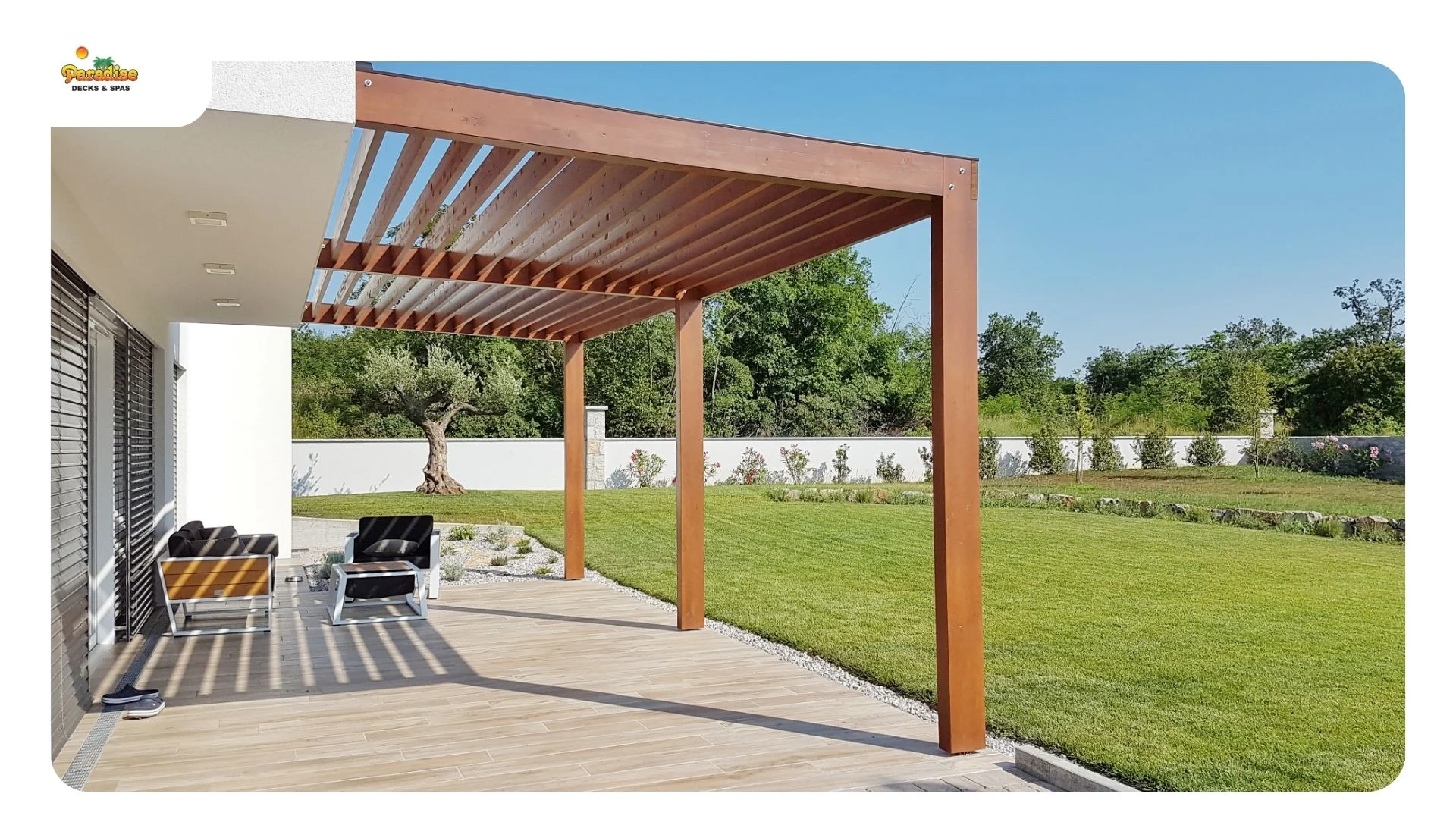
Pergola installation in San Antonio generally runs $4,000 to $30,000, which is a wide band because a cedar frame and a motorized louvered roof are barely the same product.
| Type | Typical installed cost | 12×16 example |
|---|---|---|
| Pressure-treated pine, freestanding | $3,500 – $7,000 | $4,500 – $6,500 |
| Western Red Cedar | $5,000 – $12,000 | $6,500 – $10,000 |
| Powder-coated aluminum | $7,000 – $16,000 | $9,000 – $14,000 |
| Fiberglass | $9,000 – $18,000 | $11,000 – $16,000 |
| Louvered aluminum, motorized | $15,000 – $30,000+ | $18,000 – $28,000 |
Planning figures for the San Antonio area as of 2026. Verify against current Paradise pricing before publishing.
What moves the number beyond material: span (fewer posts means heavier beams), attachment (attached structures need a permit and flashing detail), footings (expansive clay lots need deeper piers), electrical if you want fans or lights, and the city permit fee, which for a patio or porch cover runs around $160 plus the engineer’s letter.
Every quote is fixed and written before we start.
Bexar County and inner metro: San Antonio · Stone Oak · Alamo Heights · Helotes · Converse · Universal City
Comal, Guadalupe, Kendall, and Bandera counties: Boerne · Bulverde · New Braunfels · Canyon Lake · Schertz · Cibolo · Bandera · Lake Medina
Pergolas draw more HOA scrutiny than decks do, because they’re visible above the fence line. Stone Oak, Timberwood Park, Fair Oaks Ranch, and the newer Bulverde subdivisions commonly review height, color, and placement before construction. We confirm architectural approval before ordering material.
How much does a pergola cost installed in San Antonio?
Pergola installation in San Antonio typically runs $4,000 to $30,000 depending on material. A cedar pergola usually lands between $5,000 and $12,000, powder-coated aluminum between $7,000 and $16,000, and a motorized louvered system from $15,000 up. Span, attachment, footings on clay soil, and electrical all move the figure, and the city permit fee for a patio or porch cover runs around $160.
How much shade does a pergola actually provide?
A standard fixed-slat pergola provides roughly 40 to 60% shade at midday and very little late in the afternoon, because San Antonio’s low western sun comes in sideways under the structure. Tighter or deeper slats, east-west rafter orientation, a west-side privacy screen, a retractable canopy, or a louvered roof all increase coverage. A louvered system adjusts from roughly 40% to nearly full shade.
What is the difference between a pergola and a patio cover?
A pergola has an open slatted roof that filters sunlight and lets rain through. A patio cover has a solid roof that provides full shade and rain protection but blocks light into rooms behind it. A louvered pergola sits between the two, with adjustable blades that open for sun and close for shade and light rain.
Can a pergola be attached to the house or must it be freestanding?
Either. The practical difference in San Antonio is regulatory: the city requires a permit for a patio or porch cover that exceeds 300 square feet or is attached to the dwelling, so attaching triggers a permit at any size. Freestanding structures under 300 square feet generally do not, though zoning setbacks still apply. Attached structures also need careful flashing where they meet the house.
What materials do you build pergolas from?
Western Red Cedar, powder-coated aluminum, pressure-treated pine, fiberglass, and louvered aluminum systems. Cedar gives the classic warm look but checks in our heat and needs sealing every two to three years. Aluminum needs no maintenance, spans further with fewer posts, and is what we most often recommend for full-sun installations here.
Paradise Decks & Spas
Adress: 10615 Perrin Beitel, Suite 604 San Antonio, TX 78217
Phone: (210) 496-3325
Email: info@paradisedecksandspas.com
Hours: Monday – Friday 9:00 AM – 5:00 PM · Saturday 9:00 AM – 4:00 PM · Sunday Closed
Serving San Antonio and surrounding areas including Stone Oak, Alamo Heights, Helotes, Schertz, Cibolo, Converse, Universal City, Boerne, Bulverde, New Braunfels, Canyon Lake, Bandera, and Lake Medina.