
You light surfaces, not eyes. Keep every source either below knee height, shielded inside a rail channel, or high enough overhead to point down, use warm 2700K light, and keep individual fixtures dim. Most bad deck lighting is not badly placed, it is simply too bright. If you are looking for deck lighting near me, the fixture count matters far less than where the light lands.
By Rick Hogue, Founder & Lead Deck Specialist · Last updated October 2026
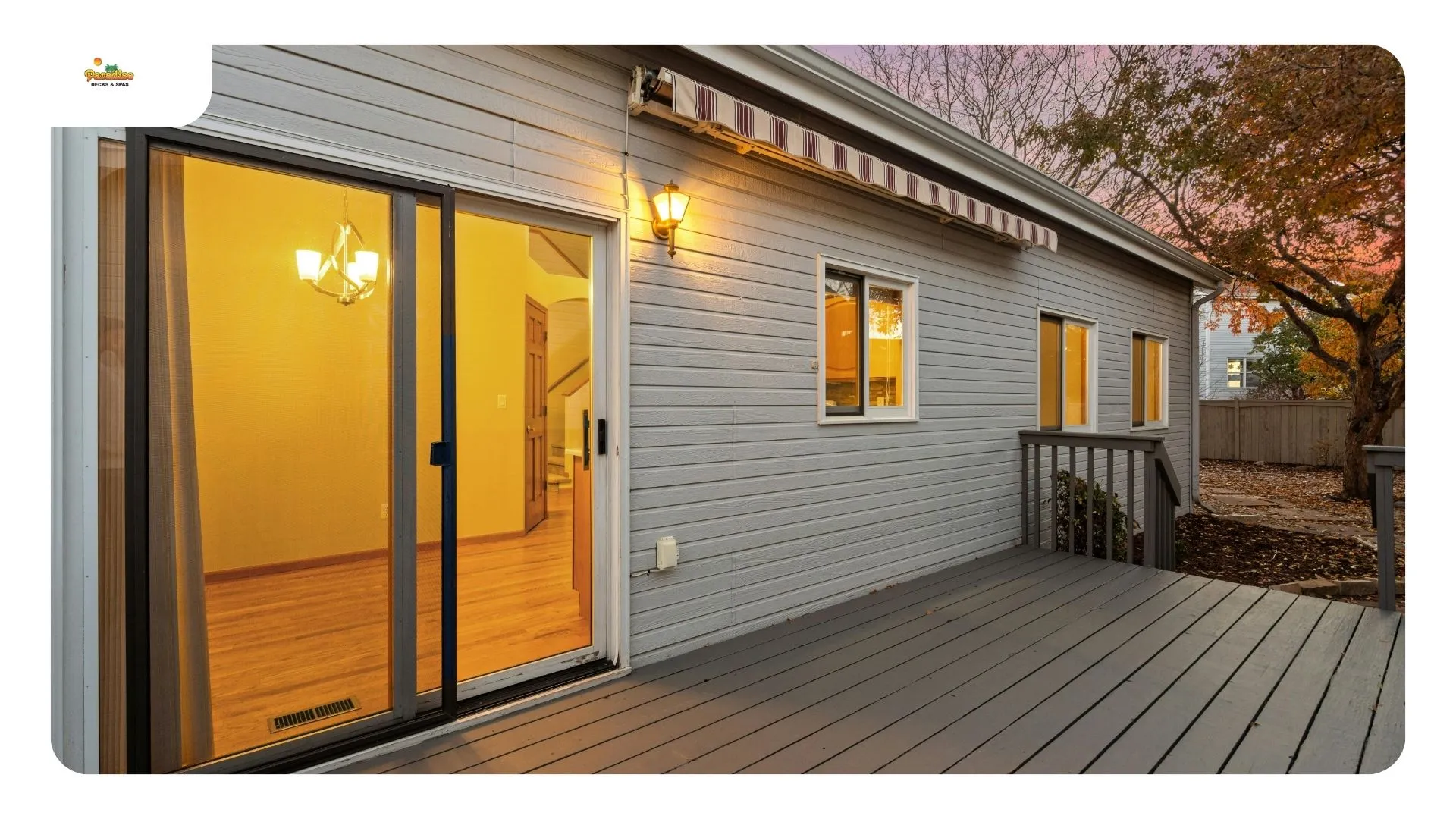
Glare happens when a light source sits in your field of view instead of the light it produces. Three mistakes cause nearly all of it.
Fixtures at seated eye level. Post cap lights are the usual culprit. A bright cap sits right where your eyes land when you are sitting down, so you see the bulb instead of the deck. Caps still work, but they need to be low output and frosted, in the range of a nightlight rather than a porch light.
Over lighting. Deck lighting is wayfinding and atmosphere, not task lighting. Individual fixtures in the range of a few watts and a few dozen lumens are correct. People used to indoor lighting numbers specify ten times what they need, then wonder why the deck feels like a gas station.
Cool color temperature. Anything at 4000K or above reads clinical outdoors and makes skin and wood look wrong. Stay at 2700K or warmer, and keep every fixture on the deck at the same temperature. Mixed color temperatures look like a mistake even when nobody can say why.
The fix in every case is indirect light: a riser light washing down a tread, a strip hidden in a rail channel pointing at the floor, a downlight mounted in a pergola or the house eave that lands on the deck surface rather than in your eyes.
A good layout uses three layers that do different jobs, and it is the layering that makes glare free deck and step lighting in San Antonio work without a single bright fixture anywhere.
Safety layer. Stair risers, step edges, and any grade change. This is the one layer that is not optional, and it is the layer that should run every night. Riser lights recessed into each step, or a shielded strip under the stair nosing, mark the tread edge without putting anything in your eyes.
Perimeter layer. Light that defines the shape of the deck and keeps people away from the edge. Under rail strips, post lights, or recessed floor lights set into the decking near the perimeter. This layer does most of the work on atmosphere.
Overhead and accent layer. Downlights in a pergola or patio cover, moonlighting mounted high in a nearby oak aiming down through the branches, or grazing light on a stone wall or planting bed. This is what keeps the deck from feeling like a lit island in a dark yard, and it is where the biggest visual payoff is.
Then one practical addition: task light at the grill or outdoor kitchen, on its own control, bright enough to cook by and off the rest of the time.
Zones, and this is the upgrade people appreciate most after a year of use.
Running everything off one switch means the only choice you have is all on or all off. You end up with cooking brightness at 10 PM or a dark deck at dinner. Deck lighting zones and dimming in San Antonio usually get set up as three:
| Zone | What it runs | How it is controlled |
|---|---|---|
| Safety | Stair risers, step edges, grade changes | Photocell or timer, on dusk to dawn, no thinking required |
| Ambience | Rail, post and perimeter lighting | Dimmable, set to taste for the evening |
| Task | Grill, outdoor kitchen, work areas | Separate switch, on only when in use |
Low voltage systems make this straightforward, since a transformer with multiple taps or zone outputs can feed each group independently. Dimming and phone control are a matter of choosing a transformer and controller that support them, which is a decision best made at design rather than bolted on later.
Phone control is worth having for the ambience zone specifically. It is less about gadgetry and more about not walking back inside to a switch panel when you want the light down two notches.
Yes, and retrofits are a large share of the lighting work we do.
Low voltage systems run on 12 volts from a transformer, and that wire can be run along the underside of joists, through the frame, and up into fixtures without disturbing the deck surface. On an open frame deck with access underneath, a retrofit is clean work.
What gets harder on an existing deck:
On power: the 12 volt side is low voltage work. The transformer has to land on a suitable exterior GFCI outlet, and if a new outlet or circuit is needed, that is line voltage work for a licensed electrician, which Texas regulates at the state level. We coordinate that so the lighting plan and the electrical work line up rather than one waiting on the other. <!– CONFIRM: in house vs subcontracted electrician –>
If you are planning a new build rather than a retrofit, lighting belongs in the deck design conversation, because wire chases and fixture locations are nearly free to plan and expensive to add later.
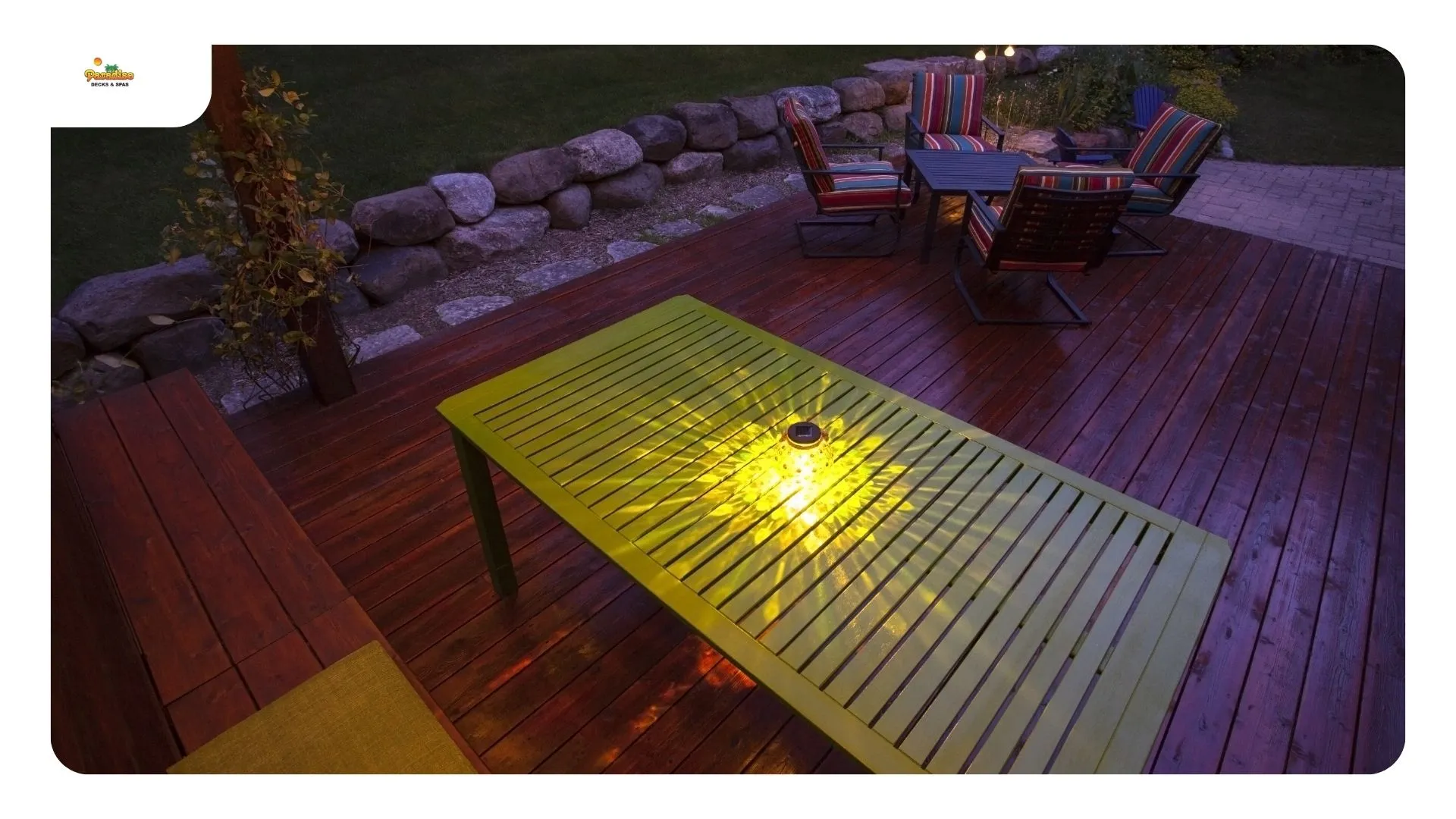
Two local constraints that catch people out.
Heat and humidity kill cheap fixtures, not the LEDs. LED chips are rated for tens of thousands of hours, but that rating assumes the heat gets out. A plastic housing on a composite deck surface at 100 degrees cooks the driver, and the fixture fails years early. Die cast aluminum, brass or copper housings dissipate heat and survive. The other failure point is connections: our humidity and irrigation overspray corrode crimped or twisted splices quickly, so every connection should be a sealed, gel filled or silicone connector rated for direct burial. Fixtures should carry an ingress rating suitable for wet locations, not just damp.
Parts of San Antonio sit under a military lighting overlay. Areas within five miles of Camp Bullis and Camp Stanley, along with Lackland and Randolph, fall under the city’s Military Lighting Overlay District, which exists to protect night training. It calls for shielded, downward aimed lighting, with tighter standards within three miles than between three and five. Existing lighting is generally grandfathered, but significant alterations can trigger compliance. If you are on the far north side, it is worth knowing before you choose fixtures. The city’s MLOD overview explains the zones, and the Camp Bullis area map shows the boundary.
The useful part: shielded, downward aimed, warm and low output is exactly what good deck lighting looks like anyway. The overlay asks for the same thing a glare free design asks for.
Ready to plan a layout? See deck lighting, or read our guide to deck design for difficult yards if the deck itself is still on paper.
How do you light a deck without creating glare?
By lighting surfaces rather than eyes. We keep sources below knee height, shielded inside rail channels, or mounted high enough to aim down. Every fixture runs warm at 2700K or lower and at low output, because deck lighting is wayfinding and atmosphere, not task lighting. Over lighting causes more glare complaints than bad placement.
Can lighting be added to a deck that is already built?
Yes. Low voltage wire runs along the underside of joists and up into fixtures without disturbing the deck surface, so retrofits are common. Rail and riser lighting retrofit most cleanly. Recessed floor lights are possible but mean drilling installed decking. Decks with sealed skirting and no access underneath are the hardest case.
Should the lighting be zoned or run from a single switch?
Zoned. We typically set three: a safety zone on a photocell or timer for stairs and grade changes, a dimmable ambience zone for rail and perimeter lighting, and a separate task zone for the grill or outdoor kitchen. One switch for everything leaves you choosing between cooking brightness and darkness.
Can the lighting be dimmed or controlled from a phone?
Yes, if the system is specified for it. Dimming and app control come from the transformer and controller rather than the fixtures, so it is a design decision rather than an upgrade. We generally recommend phone control on the ambience zone and leave the safety zone on an automatic dusk to dawn schedule.
Do your deck lights hold up to intense summer heat and humidity?
The ones we specify do. We use die cast aluminum, brass or copper housings rather than plastic, because heat dissipation is what determines whether an LED reaches its rated life on a 100 degree deck. Every connection is a sealed, gel filled connector, since humidity and sprinkler overspray corrode ordinary splices within a couple of seasons.
Paradise Decks & Spas
Adress:10615 Perrin Beitel, Suite 604 San Antonio, TX 78217
Phone: (210) 496-3325
Email: info@paradisedecksandspas.com
Hours: Monday to Friday 9:00 AM to 5:00 PM · Saturday 9:00 AM to 4:00 PM · Sunday Closed
Designing and installing deck lighting across San Antonio and the surrounding Hill Country, including Stone Oak, Alamo Heights, Helotes, Boerne and Bulverde. See the full service area.