
The deck lighting in San Antonio, TX that survives more than two summers is low-voltage LED, sealed to IP65 or better, mounted where heat and sprinkler spray can’t reach the driver. Paradise Decks & Spas designs and installs those systems on new decks and retrofits across Bexar County.
By Rick Hogue, Founder & Lead Deck Specialist · Last updated 6th August 2026
We get called out to fix other people’s lighting almost as often as we install our own. The pattern is nearly always the same: someone bought a strip kit or a set of solar post caps in April, they looked great through May, and by the second August half the run is dead or the color has drifted to a sickly blue. Most outdoor deck lights San Antonio TX homeowners pull off a big-box shelf aren’t cheap — they’re just not built for here.
Three local conditions do most of the damage, and none of them show up on a fixture’s packaging.
Surface temperature, not air temperature. A dark composite board on a south-facing deck off Loop 1604 can run 40–50°F above ambient on an August afternoon. Adhesive-backed LED strip tape is the first casualty — the adhesive creeps, the strip sags off the rail underside, and moisture gets behind it. We mechanically fasten strip channel rather than trusting tape on anything that sees afternoon sun.
Hard water and sprinkler overspray. San Antonio’s Edwards Aquifer water is mineral-heavy. Overspray onto a warm lens leaves a chalky film that cuts output noticeably within a season and etches cheap acrylic permanently. We place fixtures out of irrigation arcs during design and spec glass or UV-stable lenses where we can’t.
Expansive clay. The same soil movement that cracks pool decks around here shears buried low-voltage runs and pulls conduit away from transformer enclosures. We sleeve every buried run and leave service loops at both ends so seasonal movement takes up slack instead of tension.
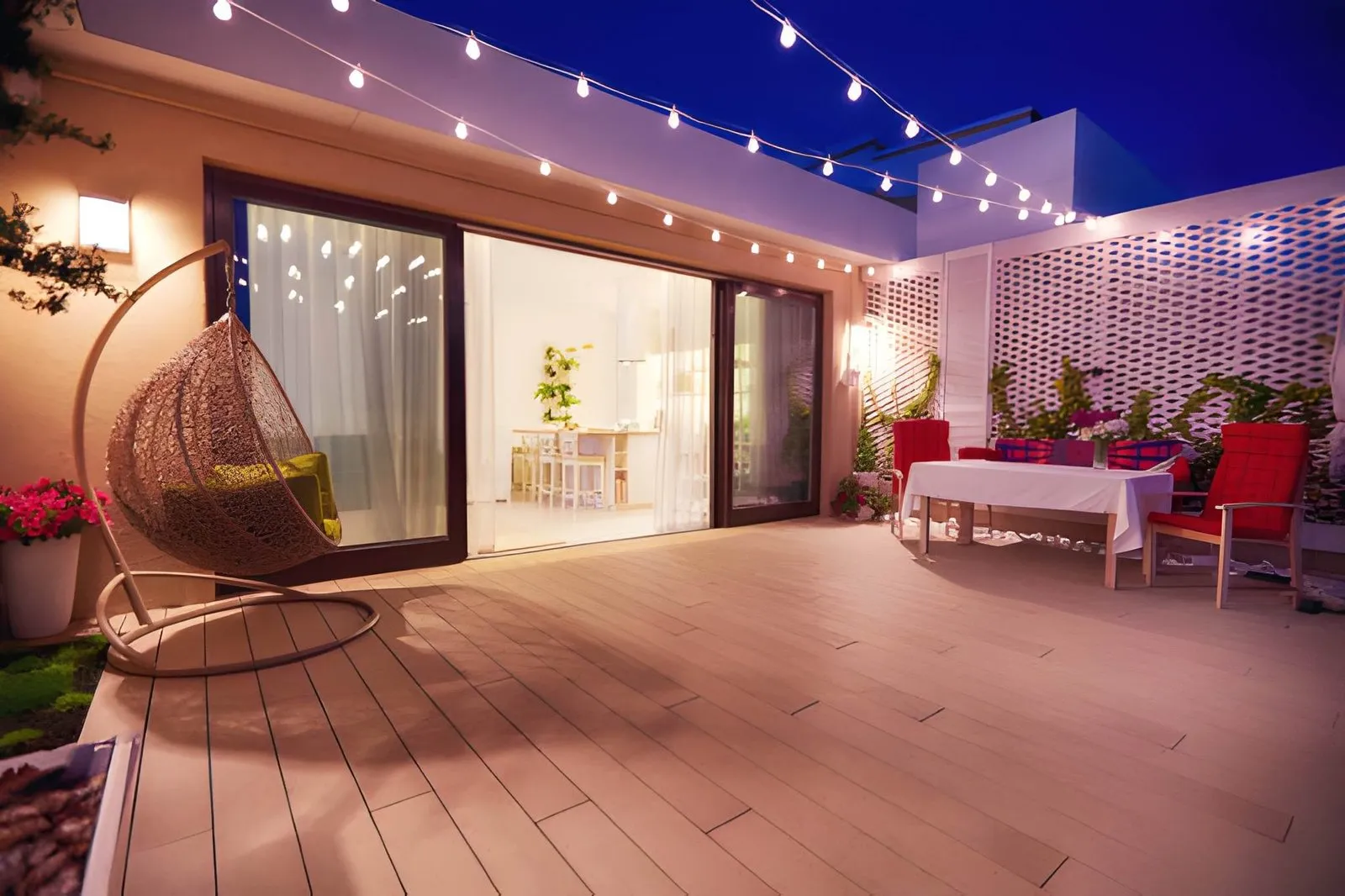
Yes — and in this climate the case is stronger than it is almost anywhere else. LED fixtures run cool, which matters when the surface they’re mounted to is already hot enough to be uncomfortable barefoot. They draw a fraction of what halogen or incandescent fixtures pull, they dim cleanly, and a quality LED post cap will outlast several rounds of bulb replacements you’d otherwise be making on a ladder in July.
The caveat is that “LED” alone tells you nothing about durability. What matters is the driver quality, the ingress rating, and the color temperature holding steady over time. We only specify fixtures rated IP65 or higher and stay in the 2700K–3000K range, because cooler color temperatures read harsh outdoors and wash out the wood or composite tone you paid for.
There is no single best fixture — there’s a best combination for your deck. A layered system beats any one fixture type, and most of the deck lighting ideas San Antonio homeowners end up loving come from stacking two or three of these:
For an older home in Alamo Heights or Terrell Hills, we often lean on post caps and step lights alone — those 1920s–1940s houses rarely have a spare exterior circuit, and a single 12V transformer on an existing GFCI outlet keeps the whole project out of panel work. On newer Stone Oak and Bulverde builds with wide, low decks, under-rail channel usually does more visual work than post caps.
This is the part most homeowners north of 1604 have never heard of. San Antonio’s Military Lighting Overlay District ordinance regulates outdoor lighting levels, intensity, and direction for properties within five miles of Camp Bullis/Camp Stanley, Randolph AFB, and Lackland AFB, with tighter limits inside the three-mile band. Practically, it means fully shielded, downward-directed fixtures and controlled light spill at the property line.
If you’re in Stone Oak, Shavano Park, Hollywood Park, or the Camp Bullis side of Helotes, that rules out uplighting and unshielded globes — but it barely touches a well-designed deck plan, because good deck lighting points down anyway. It’s worth knowing before you buy fixtures rather than after. Line-voltage additions also go through City of San Antonio Development Services; 12V systems generally don’t require a permit.
Deck lighting installation San Antonio projects typically run $1,800–$3,500 for a basic low-voltage system with post caps and stair lights on a 300–400 sq ft deck, and $3,500–$6,500 for a full layered system with under-rail strip, a smart transformer, and app control. Retrofits onto an existing deck land in the same ranges plus modest wiring-access labor. Every quote we issue is fixed and written. (Pricing current as of August 2026.)
Two things move that number more than anything else: post count and whether you want smart control. If you’re comparing across the metro, our Schertz deck lighting cost breakdown shows how the same system prices out east of the city.
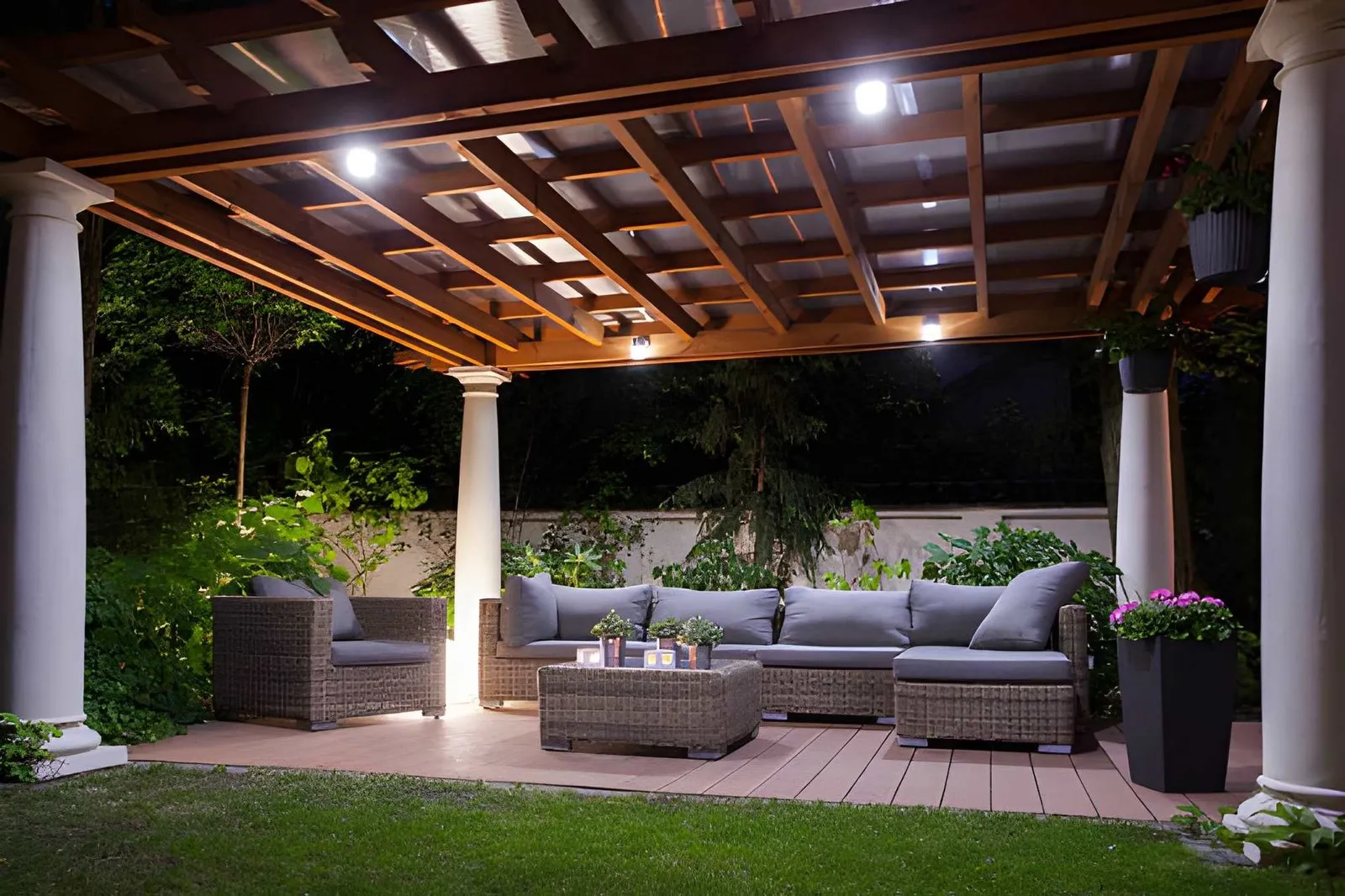
If you’ve searched “best deck lighting installer near me San Antonio, TX” at 9 PM standing on a dark deck, you already know the problem you’re trying to solve. We’ve been the deck lighting company San Antonio, Texas, homeowners call for that since 2006, and we install as part of a new build or as a standalone retrofit on a deck someone else built.
Primary service area: San Antonio, TX — including Stone Oak, Alamo Heights, Shavano Park, Hollywood Park, and the Perrin Beitel corridor near our showroom.
Surrounding communities: Helotes, Converse, Boerne, Bulverde, Schertz, Cibolo, Universal City, New Braunfels, Canyon Lake, Bandera, and Lake Medina. See the full service area map.
One thing to look for when you search outdoor lighting installer near me San Antonio: whether the same company builds the deck. Our lighting crew and our carpentry crew are the same in-house team, which is why we can run conduit before boards go down on a new deck construction job, or coordinate lighting without a third party in the middle. Our deck lighting service page covers fixture types in more detail.
A recent client summed up the standard we’re after after his final walkthrough: he “couldn’t find one thing wrong.” That’s the bar.
A basic low-voltage system with post cap and stair lighting on a 300–400 sq ft deck runs $1,800–$3,500 installed. A full layered system with under-rail strip, smart transformer, and app control runs $3,500–$6,500. We provide a fixed written quote after a free on-site walkthrough — no hourly billing and no mid-install upsells.
Layering beats any single fixture. Post caps on every railing post plus recessed step lights on every riser is the baseline. Add warm-white under-rail channel for ambient glow, downward accent lights on nearby trees or planters, and smart scene presets for entertaining, ambient, and security modes.
Wired low-voltage wins for anything where output has to be consistent — stairs, railings, entertaining areas. San Antonio’s 220-plus sunny days make solar viable, but heat shortens battery life and output drops after cloudy stretches. We use solar deck lights for detached structures and fence lines where running wire isn’t practical.
Yes, and it’s about half the work we do. We route low-voltage wire along joists and through pre-drilled holes, patch and weatherproof every penetration, and mount the transformer at an existing exterior GFCI outlet. It works on any deck regardless of who built it — including ones we didn’t.
Paradise Decks & Spas 10615 Perrin Beitel, Suite 604 San Antonio, TX 78217 Phone: (210) 496-3325 Hours: Monday–Friday 9:00 AM – 4:00 PM · Saturday and Sunday Closed
Serving San Antonio and surrounding areas including Stone Oak, Alamo Heights, Helotes, Converse, Boerne, and Bulverde.
Ready to use your deck after dark? Get a free lighting quote or call (210) 496-3325.